 MATCDHAKA – Medical Assistant Training Centre in Dhaka Pharmacy, Veterinary, Dental, Nursing, Pathology, Physiotherapy and Homeopathy Training Institute in Dhaka



Diploma in Medicine and Surgery (DMS) Course Profile Details:
Diploma in Medicine and Surgery ( DMS 1 Year):
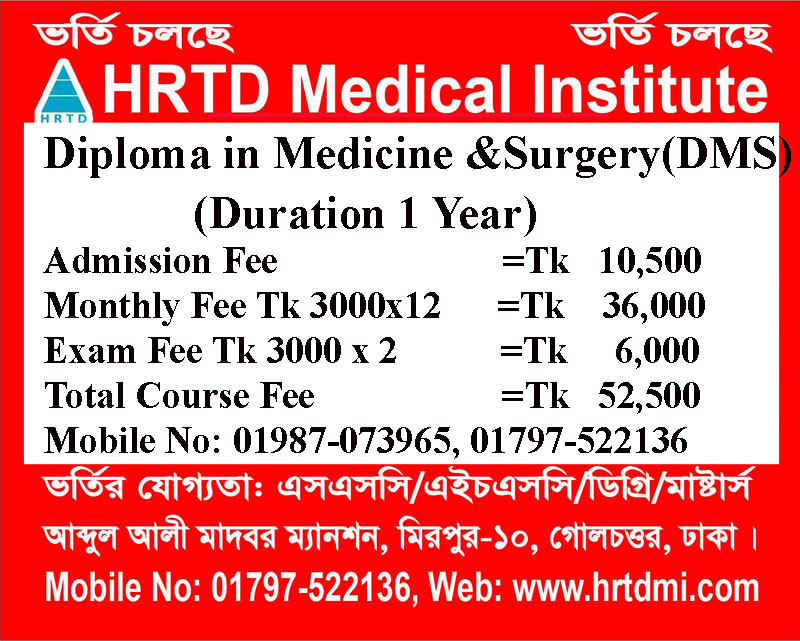
Diploma in Medicine and Surgery ( DMS 1 Year). This course contains 10 subjects. The subjects are Human Anatomy & Physiology, Pharmacology-1, Practice of Medicine, Hematology, Pathology, Microbiology, Surgery, etc.
Diploma in Medicine and Surgery ( DMS 2 Year):
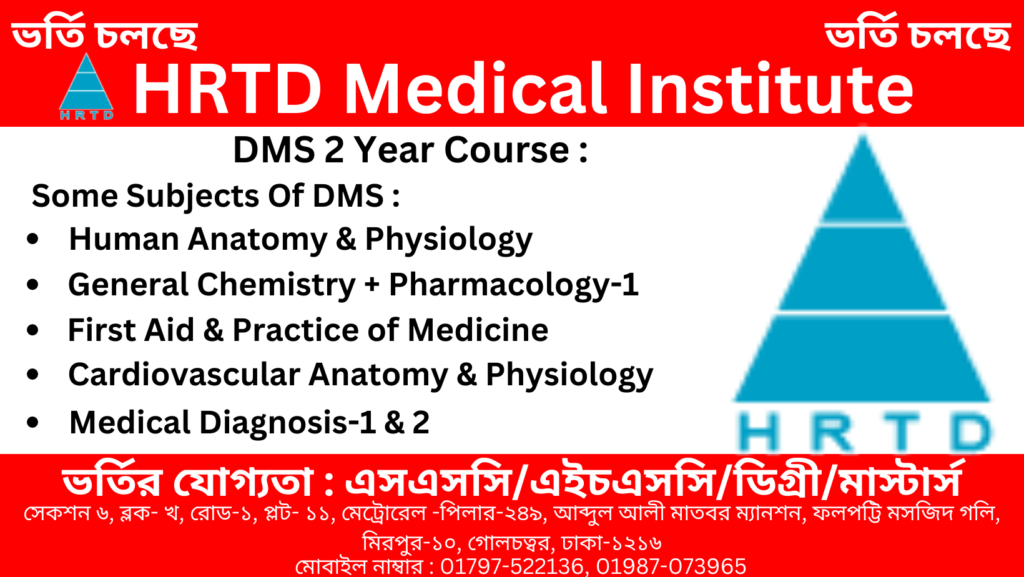
1’st Semester Diploma in Medicine and Surgery | DMS Course| 2 Year
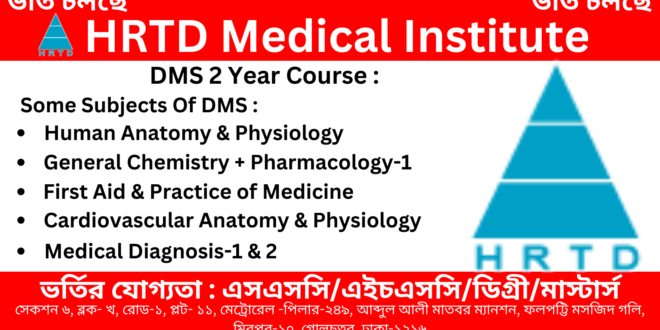
Human Anatomy & Physiology, General Chemistry + Pharmacology-1, First Aid & Practice of Medicine, Study of OTC Drugs, Hematology-1 & Pathology For M.P and so on.
2’nd Semester Diploma in Medicine and Surgery | DMS Course| 2 Year
Cardiovascular Anatomy & Physiology, Medical Biochemistry, Orthopedic Anatomy & Physiology, Surgery & Antimicrobial Drugs, Medical Diagnosis-1 & 2 and so on.
3’rd Semester Diploma in Medicine and Surgery | DMS Course| 2 Year
Anatomy & Physiology-2, Microbiology, Pharmacology-2, Pathology-1 & 2 and so on.
4’th Semester Diploma in Medicine and Surgery | DMS Course| 2 Year
Neuro Anatomy & Physiology, Histology & Cytology, Practice of Medicine-2, Respiratory Disease & Treatment and so on.
Anatomy and Physiology for Diploma in Medicine and Surgery | DMS Course| 2 Year
Anatomy and Physiology is an important subject for medical science. The study of Body Structure and its functions is Anatomy and Physiology. Here we discuss the systems of the Human Body and its Organs, Tissues, and Cells. The systems of the Human Body are the Nervous System, Digestive System, Respiratory System, Circulatory System or Cardiovascular System, Skeletal System, Muscular System, Endocrine System, Immune System, Lymphatic System, Integumentary System or Covering System, and Urinary System.

Pharmacology for Diploma in Medicine and Surgery | DMS Course| 2 Year
The study of Drugs and Medicine is called Pharmacology. Drugs are chemicals that can react with cells, tissues, and organs of the body. Here we discuss group-wise drugs and their medicines. Common Groups of Drugs are Pain Killer Drugs, Anti Ulcer Drugs, Anti Vomiting Drugs, Anti Viral Drugs, Laxative Drugs, Motility Drugs and Antimotility Drugs, Bronchodilator Drugs, Antibiotic Drugs, Anti Fungal Drugs, Anti Thrombotic Drugs, Anti Protozoal Drugs, Anthelmintic Drugs, Anti Hypertensive Drugs, Beta Blocker Drugs, Calcium Channel Blocker Drugs, ACE Inhibitor Drugs, Hemostatic Drugs, Analgesic Drugs, Antipyretic Drugs, Steroid Drugs, NSAID Drugs, CNS Drugs, Neuropathic Pain Keller Drugs, Spasmodic Drugs, etc.
First Aid for Diploma in Medicine and Surgery | DMS Course| 2 Year
First Aid is an important subject for all courses. It is very important for the RMP Course. Here we discuss Shock, Classifications of Shock, Causes of Shock, Stages of Shock, Clinical Features of Shock, Hypovolemic Shock, Cardiogenic Shock, Neurogenic Shock, Traumatic Shock, Burn Shock, Electric Shock, Psychogenic Shock, Anaphylactic Shock, First Aid of Shock, Management of Shock, First Aid of Cut, First of Snake Bite, First Aid of Accidental Injury, etc.
Study of OTC Drugs for Diploma in Medicine and Surgery | DMS Course| 2 Year
OTC is the short form of over-the-counter. That is OTC Drugs are over-the-counter drugs. The study of OTC Drugs is important for RMP Courses. These Drugs can be sold or purchased without any prescription from Registered MBBS Doctors. These Drugs are Emergency and Safe for the patients. The study of OTC Drugs improves the quality of practice. Some OTC Drugs are Paracetamol, Albendazole, Ascorbic Acid, Calcium, Multivitamins, Vitamin B Complex, Omeprazole, Oral Rehydration Salt, Salbutamol, Mebendazole, Neomycin, Gentamycin, Bacitracin, etc.
Hematology and Pathology for Diploma in Medicine and Surgery | DMS Course| 2 Year
Hematology and Pathology are important Subjects for Medical Science. The study of Blood is called Hematology and the Study of Pathos is called Pathology. In Hematology and Pathology, we discuss blood cells, their morphology and functions, Blood Diseases, Common Pathos and their pathogenesis, Atrophy, Hypertrophy, Metaplasia, Gangrene, Pathological Tests like TC, DC, ESR, Hemoglobin Percentage, etc.
Microbiology and Antimicrobial Drugs for Diploma in Medicine and Surgery | DMS Course| 2 Year
The Study of Microorganisms is called Microbiology. Microorganisms are the smallest living beings that cannot be seen without a microscope. The Drugs that are used for the treatment of Infectious Diseases are Antimicrobial Drugs. Microorganisms are Bacteria, Protozoa, Fungus, and Virus. Antimicrobial Drugs are Antibiotic Drugs ( Antibacterial Drugs), Anti Protozoal Drugs, Anti Fungal Drugs, and Anti Viral Drugs.
Pathology for Diploma in Medicine and Surgery | DMS Course| 2 Year
Pathology is the medical science studying diseases’ causes (etiology), mechanisms (pathogenesis), and effects, bridging basic science with clinical medicine to diagnose illness through lab analysis of blood, tissues, and cells, guiding treatment, and advancing research in areas like cancer, infections, and genetics, often studied in MBBS/MLT courses after 10+2 science.
What it covers
- Core Concepts: Cellular changes (adaptation, necrosis), inflammation, wound healing, neoplasia (cancer).
- Laboratory Medicine: Analysis of body fluids (blood, urine, sputum) and tissues (histopathology, cytology, immunohistochemistry).
- Sub-disciplines: General Pathology, Systemic Pathology, Microbiology, Hematology, Clinical Pathology, Forensic Pathology, Molecular Pathology.
Role in Healthcare
- Diagnosis: Identifies what’s wrong with a patient by examining samples.
- Treatment Guidance: Helps doctors choose correct treatments, monitors effectiveness.
- Research: Drives new discoveries, treatments, and understanding of diseases.
Career & Education
- Study Path: Science-based A-Levels (Biology, Chemistry) for degrees (BSc MLT, MBBS), followed by specialized training.
- Professionals: Pathologists (physicians), Medical Lab Scientists/Technicians.
- Job Roles: Medical Lab Technician, Pathologist, Clinical Scientist.
Key takeaway
Pathology is fundamental to modern medicine, providing the scientific basis for understanding, diagnosing, and treating diseases, from common illnesses to complex genetic condition
Medical Diagnosis for Diploma in Medicine and Surgery
Medical Diagnosis is the crucial process of identifying a disease, condition, or injury by analyzing a patient’s symptoms (what they feel) and signs (what doctors observe), involving history taking, physical exams, and diagnostic tests (labs, imaging) to find the underlying cause, guiding treatment and improving health outcomes. It’s a complex subject encompassing clinical reasoning, various diagnostic tools, and understanding disease patterns, with fields like pathology, radiology, and genetics contributing specialized diagnostic skills.
Core Components of Medical Diagnosis
- History Taking: Gathering subjective data like symptoms, past illnesses, family history, medications, and lifestyle.
- Physical Examination: Objective assessment of vital signs, body systems, and detection of abnormalities.
- Diagnostic Testing: Using blood tests, X-rays, MRIs, biopsies, etc., to confirm or rule out possibilities.
- Differential Diagnosis: Creating a list of potential conditions and narrowing it down.
Key Concepts
- Signs vs. Symptoms: Symptoms are subjective (e.g., pain), while signs are objective (e.g., fever, rash).
- Syndrome: A group of signs and symptoms that often occur together, indicating a particular condition (e.g., stomach flu).
- Types of Diagnoses: Clinical, provisional, differential, disease, patient-specific diagnoses.
Modern Advances & Challenges
- Technology: AI, machine learning, and advanced imaging improve accuracy and speed.
- Challenges: Overlapping symptoms, cultural variations in symptom expression, and the need for precision.
Academic Study
- As a subject, it involves pathophysiology, lab techniques (blood smears, stains), interpreting imaging, and understanding disease processes, often taught in medical schools and specialized diagnostic courses.
Practice of Medicine Diploma in Medicine and Surgery
Practice of Medicine-1 is usually the foundational clinical subject in early medical years (like MBBS Phase 3/4 or BAMS/BHMS final years), focusing on diagnosis, management, and treatment of general adult illnesses, integrating basic sciences (Anatomy, Physiology, Pathology) with clinical skills, patient communication, ethics, and understanding diseases like infections, cardiology, respiratory, GI, etc., preparing students for complex patient care.
Key Focus Areas in Practice of Medicine-1:
- Clinical Skills: History taking, physical examination, basic diagnostic procedures (ECG, X-ray interpretation).
- Disease Understanding: Etiology, pathophysiology, signs/symptoms, diagnosis, and management of common internal medicine conditions (e.g., fever, diabetes, hypertension, heart/lung/kidney diseases).
- Integration of Sciences: Connecting basic sciences (Pharmacology, Pathology, Microbiology) to real patient problems.
- Professionalism: Developing communication, empathy, ethical decision-making, and patient-centered care.
- Emergency Management: Recognizing and providing initial care for medical emergencies.
Where You Find It:
- MBBS (Bachelor of Medicine, Bachelor of Surgery): Part of Phase 3 or 4 in many curricula, often alongside Surgery, Gynae, etc..
- BHMS/BAMS (Homeopathy/Ayurveda): A key final year subject covering internal medicine principles, often with specific papers.
In essence, Practice of Medicine-1 bridges the gap between foundational science and actual patient care, teaching how to be a doctor.
Cost Summary Diploma in Medicine and Surgery
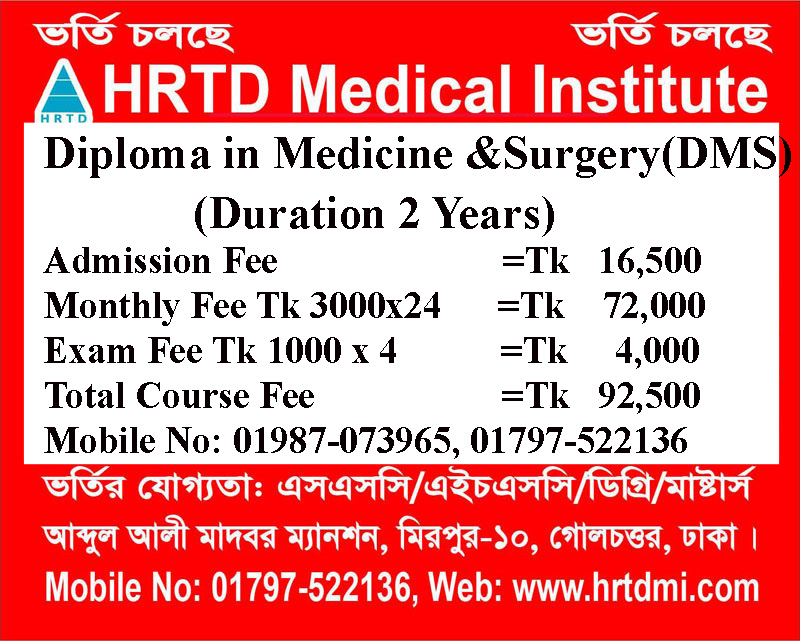
Course Duration = 2 Years
Total Subjects = 18
Total Marks 1800
Total Classes (3 x 96) = 288 Hours
Admission Fee = 16,500
Monthly Fee (24 x 3000) = 72,000
Exam. Fee ( 4 ) = 4,000
Total Course Fee = 92,500
Mobile: 01797522136, 01987073965, 01784572173
Practical Classes :
Auscultation, Heart Beat, Heart Rate, Heart Sound, Pulse, Blood Pressure, Respiratory Rate, Inhaler, Blood Grouping, CPR, Hand wash, Rota Haler, Nebulizer, Blood Oxygen, Cyanosis, Blood Glucose (Diabetes), Body Temperature, Dehydration Test, Edema Test, IM Injection, IV Injection, Saline Infusion, Cleaning, Dressing, Bandaging, Stitching.
Practical Works. Mobile Phone 01797522136, 01987073965. There are many practical works in the DMS 3 Years Course. The Practical works are Heart Beat, Heart Rate, Pulse, Pulse Rate, Weak Pulse, Strong Pulse, Atrial Beat, Ventricular Beat, Tachycardia, Bradycardia, Arrhythmia, Heart Sound, Normal Heart Sound, Abnormal Heart Sound, Cardiac Mur Mur, Blood Pressure, Systolic Blood Pressure, Diastolic Blood Pressure, Pulse Pressure, Mean Blood Pressure.
Hypertension, Hypotension, Hypertension Emergency, Management of Hypertension, Management of Hypotension, Management of Hypertension Emergency, IM Injection, IV Injection, SC Injection, ID Injection, Saline Pushing, Application of Eye Drops, Application of Pediatric Medicine, Emergency Respiratory Drugs, Use of Inhaler, Use of Ratahaler, Use of Nebulizer.
BMI, Normal Body Weight, Under Weight, Over Weight, Obesity, Cleaning, Dressing, Bandaging, Use of Mouth Anti Septic Mouth Wash, Use of Suppository, Use of Eye Drops, Use of Ear Drops, Use of Skin Ointment and Cream, Canulla Setting, Post Surgical Cleaning, Post Surgical Dressing, Post Surgical Bandaging, Post Surgical Pain Management. Roller Bandage, Triangular Bandage.
Making Suspension from PFS, Making Solution from ORS, Auscultation, Auscultation of Thorax, Respiratory Auscultation, Abdominal Auscultation, Percussion, Appendicitis Pulpation, Prescription Understanding, Report Understanding, X-Ray Report Understanding, Blood Test Report Understanding, Urine Test Report Understanding, ECG Report Understanding, Echo Report Understanding, ETT Report Understanding.
Teachers for Diploma In Medicine and Surgery Course
Dr. Sakulur Rahman, MBBS, CCD (BIRDEM)
Dr. Suhana, MBBS, PGT
Dr. Amena Afroze Anu, MBBS, PGT
Dr. Lamia, MBBS
Dr. Mahinul Islam, MBBS
Dr. Sharmin Ankhi, MBBS, PGT
Dr. Jannatul Aman, MBBS, PGT
Dr. Turzo, MBBS, FCPS (Part 2)
Dr. Benzir, MBBS, FCPS (Part 2)
Dr. Disha, MBBS, FCPS (Part 2)
Dr. Tisha, MBBS, PGT Medicine

One comment
Pingback: Best Diploma in Medicine and Surgery 1 Year, 2,3 and 4 years