 MATCDHAKA – Medical Assistant Training Centre in Dhaka Pharmacy, Veterinary, Dental, Nursing, Pathology, Physiotherapy and Homeopathy Training Institute in Dhaka



Diploma Medical Assistant Course Details
Diploma Medical Assistant. Mobile Phone Number 01797522136, 01987073965. Diploma Medical Assistant is a Medical Assistant Course. The short form of this course is DMA. The 2-year Diploma Medical Assistant Course Contains 18 Subjects.
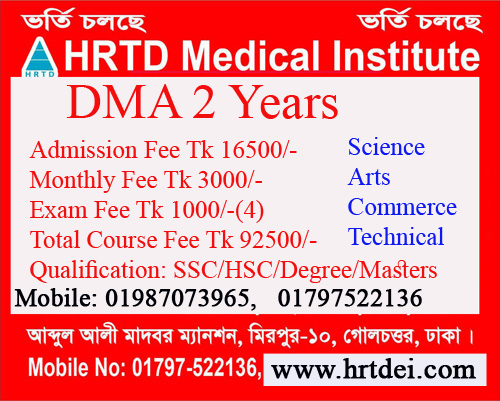
1st Semester contains 5 Subjects, 2nd Semester contains 5 Subjects, 3rd Semester contains 4 Subjects and 4th Semester contains 4 Subjects. Total Course Fee Tk 92500/- including Admission Fee Tk 16500/-, Monthly Tk 3000/-, and Exam Fee. Best Diploma Medical Assistant is conducted by HRTD Medical Institue.
Qualification for Admission to Diploma Medical Assistant Course
SSC/HSC/Bachelor Degree/Master Degrees. The minimum Qualification is an SSC Pass from any Science/Arts/Commerce background.
DMA Course In Dhaka
- Course Summary :
- Total Subjects: 18
- Total Exam Marks: 1800
- Total Semester: 4
First Semester Subjects in DMA 2 Years Course
- Human Anatomy & Physiology…………………..….…..Marks-100
- General Chemistry + Pharmacology-1…………….….Marks-100
- First Aid & Practice of Medicine…………….……..…….Marks-100
- Study Of OTC Drugs……………………………………….…….Marks-100
- Hematology-1 & Pathology for M.P………………….…Marks-100
2’nd Semester Subjects in DMA 2 Years Course
- Cardiovascular Anatomy & Physiology……………..…Marks-100
- Medical Biochemistry…………………………………………….Marks-100
- Orthopedic Anatomy & Physiology………………….…..Marks-100
- Surgery-1 & Antimicrobial Drugs…………………………Marks-100
- Medical Diagnosis-1 & 2……………………………….….…..Marks-100
3’rd Semester Subjects in DMA 2 Years Course
- Anatomy & Physiology-2……………………………………..Marks-100
- Microbiology…………………………………………………..……Marks-100
- Pharmacology……………………………………………………….Marks-100
- Pathology-1 & 2………………………………………….………..Marks-100
4’th Semester Subjects in the DMA 2 Years Course
- Neuro Anatomy & Physiology……………….……………Marks-100
- Histology & Cytology…………………………………………..Marks-100
- Practice of Medicine………………………………………..……Marks-100
- Respiratory Disease & Treatment…………………………Marks-100
Location for DMA Course in Bangladesh
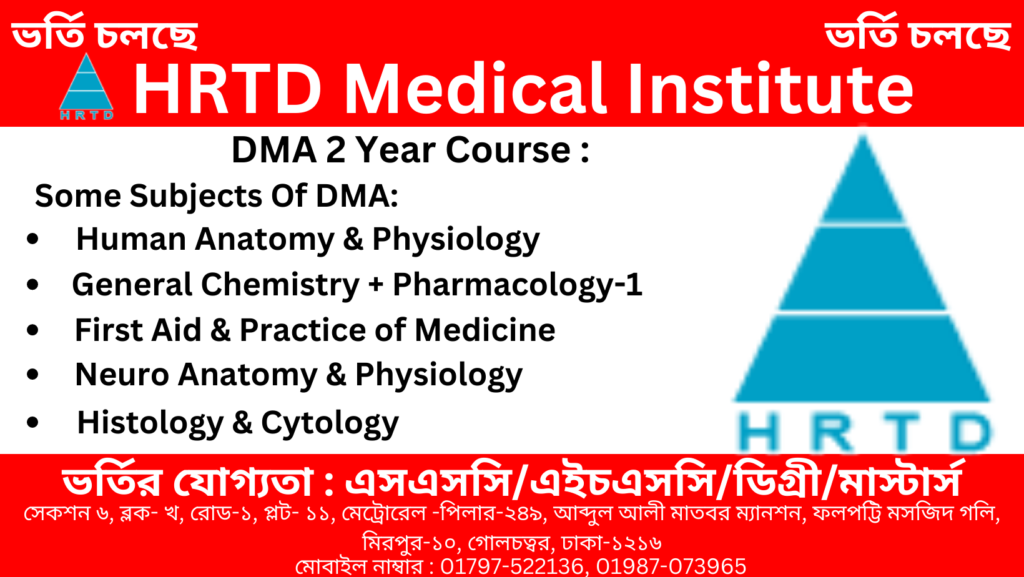
Location for DMA Course: Mobile Phone Number 01797522136, 01987073965. HRTD Medical Institute, Abdul Ali Madbor Mansion, Section-6, Block-Kha, Road-1, Plot-11, Metro Rail Piller No. 249, Mirpur-10 Golchattar, Dhaka-1216.
Anatomy and Physiology for DMA Course
Anatomy and Physiology is an important subject for medical science. The study of Body Structure and its functions is Anatomy and Physiology. The systems of the Human Body are the Nervous System, Digestive System, Respiratory System, Cardiovascular System, Skeletal System, Muscular System, Endocrine System, Immune System, Lymphatic System, Covering System, and Urinary System.
Pharmacology for Diploma Medical Assistant Course
The study of Drugs and Medicine is called Pharmacology. Drugs are chemicals that can react with cells, tissues, and organs of the body. Common Groups of Drugs are Pain Killer Drugs, Anti Ulcer Drugs, Anti Vomiting Drugs, Anti Viral Drugs, Laxative Drugs, Motility Drugs and Antimotility Drugs, Bronchodilator Drugs, Antibiotic Drugs, Anti Fungal Drugs, Anti Thrombotic Drugs, Anti Protozoal Drugs, Anthelmintic Drugs, Anti Hypertensive Drugs, Beta Blocker Drugs, Calcium Channel Blocker Drugs, ACE Inhibitor Drugs, Hemostatic Drugs, Analgesic Drugs, Antipyretic Drugs, Steroid Drugs, NSAID Drugs, CNS Drugs, Neuropathic Pain Keller Drugs, Spasmodic Drugs etc.
First Aid for Diploma Medical Assistant Course
First Aid is an important subject for all courses. It is very important for the DMA Course. Here we discuss Shock, Classifications of Shock, Causes of Shock, Stages of Shock, Clinical Features of Shock, Hypovolemic Shock, Cardiogenic Shock, Neurogenic Shock, Traumatic Shock, Burn Shock, Electric Shock, Psychogenic Shock, Anaphylactic Shock, First Aid of Shock, Management of Shock, First Aid of Cut, First of Snake Bite, First Aid of Accidental Injury etc.
Study of OTC Drugs for Diploma Medical Assistant Course
OTC is the short form of over-the-counter Drugs. That is OTC Drugs are over-the-counter drugs. The study of OTC Drugs is important for DMA Courses. These Drugs can be sold or purchased without any prescription from Registered MBBS Doctors. These Drugs are Emergency and Safe for the patients. The study of OTC Drugs improves the quality of practice. Some OTC Drugs are Paracetamol, Albendazole, Ascorbic Acid, Calcium, Multivitamins, Vitamin B Complex, Omeprazole, Oral Rehydration Salt, Salbutamol, Mebendazole, Neomycin, Gentamycin, Bacitracin etc.
Hematology and Pathology for Diploma Medical Assistant Course
Hematology and Pathology are important Subjects for Medical Science. The study of Blood is called Hematology and the Study of Pathos is called Pathology. In Hematology and Pathology, we discuss blood cells, their morphology and functions, Blood Diseases, Common Pathos and their pathogenesis, Atrophy, Hypertrophy, Metaplasia, Gangrene, Pathological Tests like TC, DC, ESR, Hemoglobin Percentage, etc.
Microbiology or Antimicrobial Drugs for Diploma Medical Assistant Course
The Study of Microorganisms is called Microbiology. Microorganisms are the smallest living beings that cannot be seen without a microscope. The Drugs that are used for the treatment of Infectious Diseases are Antimicrobial Drugs. Microorganisms are Bacteria, Protozoa, Fungus, and Virus. Antimicrobial Drugs are Antibiotic Drugs ( Antibacterial Drugs), Anti Protozoal Drugs, Anti Fungal Drugs, and Anti Viral Drugs.
Microbiology is the scientific study of microscopic organisms (microbes) like bacteria, viruses, fungi, archaea, and protozoa, encompassing their structure, function, evolution, and roles in ecosystems and disease, with key branches including bacteriology, virology, and mycology, and vital applications in medicine, industry, and environmental science.
Key Aspects
- Organisms Studied: Bacteria, viruses, fungi (molds, yeasts), protozoa, algae, archaea, and even some small multicellular organisms like helminths.
- Sub-disciplines: Virology (viruses), Bacteriology (bacteria), Mycology (fungi), Parasitology (parasites), Immunology (immune response), and more.
- Importance: Microbes are crucial for life, aiding digestion, fixing nitrogen, decomposing matter, and are vital in producing antibiotics, vaccines, and fermented foods.
- Disease: While most microbes are harmless or beneficial, pathogens (disease-causing microbes) are studied to understand infections, develop treatments (like antibiotics), and create vaccines.
- Techniques: Involves culturing, microscopy, genetic analysis, and various isolation methods to study microbial life.
Why it Matters
- Health: Understanding pathogens and the human microbiome (beneficial microbes in our bodies).
- Environment: Role in nutrient cycles and ecosystem health.
- Industry: Used in food production (yogurt, bread) and biotechnology.
- History: Key to discoveries like penicillin and vaccines, fundamentally shaping modern science and health.
Antimicrobial drugs are medicines used to treat and prevent infectious diseases caused by microbes like bacteria, viruses, fungi, and parasites. These drugs include antibiotics, antivirals, antifungals, and antiparasitics, and work by killing microbes or inhibiting their growth without harming the host’s cells (selective toxicity). They are used in human, animal, and plant medicine to manage infections and can be administered orally, intravenously, or topically.
Types of antimicrobial drugs
- Antibiotics: Target bacterial infections by killing bacteria (bactericidal) or stopping their multiplication (bacteriostatic).
- Antivirals: Eliminate viruses or inhibit their life cycle.
- Antifungals: Kill or inhibit the growth of fungi, including yeasts.
- Antiparasitics: Treat infections caused by parasites like nematodes, cestodes, and protozoa.
Key characteristics
- Selective toxicity: The ability to kill or inhibit microbes without causing serious damage to the host’s cells.
- Spectrum of activity:
- Broad-spectrum: Effective against a wide range of bacteria.
- Narrow-spectrum: Effective against a specific type of organism.
- Mechanisms of action: Drugs may kill bacteria by stopping them from building cell walls, while others stop their reproduction.
Important considerations
- Antimicrobial resistance: A major global health threat that occurs when microorganisms evolve and become unresponsive to antimicrobial drugs.
- Proper use: Antimicrobial drugs should be used only when prescribed by a physician, veterinarian, or agricultural expert to manage infections.
- Delivery methods: They can be administered in various ways, including orally (by mouth), parenterally (intravenously or intramuscularly), or topically (as a cream or ointment).
Pathology for Diploma Medical Assistant Course
Pathology is the medical study of disease, focusing on its causes (etiology), mechanisms (pathogenesis), structural changes (morphology), and functional consequences, acting as the bridge between basic science and clinical medicine by analyzing tissues, fluids, and organs to diagnose illnesses like cancer, infections, and inflammatory conditions, and guiding treatment through laboratory analysis. Pathologists use techniques from gross examination to advanced genetic studies, making crucial diagnoses from biopsies, blood tests, and autopsies, making it fundamental to modern healthcare.
What it is:
- Study of Disease: Pathology investigates any deviation from normal body function or structure, from cellular changes to systemic effects.
- Diagnostic Science: It’s central to laboratory medicine, examining bodily fluids (blood, urine) and tissue samples (biopsies) to identify diseases.
- Scientific Basis: It explores disease processes, including cell injury (necrosis), inflammation, and abnormal cell growth (neoplasia).
Key Areas & Functions:
- Histopathology & Cytopathology: Microscopic examination of tissues (histo) and cells (cyto) for diagnosis.
- Clinical Pathology: Analysis of blood, urine, and other body fluids (e.g., hematology, microbiology).
- Autopsy: Post-mortem examination to determine cause of death or study disease.
- Cancer Diagnosis: Pathologists are vital for identifying and staging cancers.
- Infectious Diseases: Identifying pathogens, crucial for combating viruses like COVID-19.
How it works:
- Pathologists (doctors) and scientists analyze specimens using microscopes, chemical tests, and genetic tools.
- They produce detailed reports that guide other clinicians in patient care, treatment monitoring, and prognosis.
In essence:
Pathology provides the crucial understanding and evidence needed to diagnose, treat, and monitor nearly all illnesses, making it the “science behind the cure”.
Medical Diagnosis for Diploma Medical Assistant Course
Medical Diagnosis is an important subject for Diploma Medical Assistant Course. Medical diagnosis is the process of identifying a disease or condition based on a person’s signs and symptoms. It involves a healthcare provider gathering information through a patient’s medical history, a physical examination, and various tests, such as blood work or imaging scans, to determine the most likely cause of their illness. The diagnosis then guides the selection of the most appropriate treatment.
The diagnostic process
- Medical history: The process begins with the patient describing their symptoms and any relevant medical history, including family history, current medications, and lifestyle.
- Physical exam: The healthcare provider will conduct a physical examination, checking vital signs and looking for any abnormalities.
- Diagnostic tests: Further tests may be ordered to confirm a diagnosis or narrow down the possibilities. These can include:
- Blood tests: Analyze blood samples for various indicators of disease.
- Imaging tests: X-rays, CT scans, MRIs, and other imaging technologies provide internal views of the body.
- Biopsies: Examining a small sample of tissue under a microscope for microscopic analysis.
- Differential diagnosis: Sometimes, when a single diagnosis isn’t clear, a provider will consider multiple possibilities. They may then monitor how the patient responds to different treatments to determine the correct diagnosis.
- Final diagnosis: Once enough information is gathered from the provisional findings and investigations, a final diagnosis can be made.
Why diagnosis is important
- Guides treatment: A correct diagnosis is crucial for developing an effective treatment plan, which can include medication, therapy, or lifestyle changes.
- Facilitates communication: It provides a common language for healthcare providers to communicate with each other and with the patient about the condition.
- Advances medical knowledge: Diagnoses help build a comprehensive understanding of diseases, contributing to medical science and the development of new treatments.
Orthopedic Anatomy and Physiology for Diploma Medical Assistant Course
Orthopedic Anatomy & Physiology studies the musculoskeletal system (bones, muscles, joints, ligaments, tendons, nerves) and how it functions, providing the framework for movement, support, and organ protection, with its physiology covering dynamic processes like bone remodeling (osteogenesis) and muscle contraction, crucial for understanding and treating injuries, sports trauma, arthritis, and degenerative diseases. It details bone types (long, short, flat), muscle actions (agonist/antagonist), and nerve pathways, essential for healthcare professionals treating conditions from fractures to joint pain.
Key Anatomical Components
- Bones: Provide structure, protect organs, aid locomotion, store minerals (e.g., femur, vertebrae, skull).
- Muscles: Contract to create movement, working in antagonistic pairs (e.g., biceps/triceps).
- Joints: Where bones meet (e.g., hip, knee, elbow), allowing movement, often cushioned by cartilage.
- Ligaments: Connect bone to bone, stabilizing joints.
- Tendons: Connect muscle to bone, transmitting force (e.g., patellar tendon).
- Nerves: Transmit signals for muscle control and sensation (e.g., brachial plexus nerves).
Key Physiological Processes
- Bone Remodeling: Continuous process where old bone is removed and new bone is formed, responding to stress (Wolff’s Law).
- Muscle Physiology: Covers excitation-contraction coupling, energy sources (ATP), and types of muscle fibers.
- Biomechanics: How forces act on the body, impacting joint loading and movement mechanics.
Clinical Relevance
- Treating Injuries: Understanding anatomy helps diagnose and treat fractures, sprains, and dislocations.
- Rehabilitation: Guides physical therapy for restoring movement and function after injury or surgery.
- Disease Management: Explains conditions like arthritis (cartilage wear) or muscle weakness (osteosarcopenia).
Neuro Anatomy and Physiology for Diploma Medical Assistant
Neuroanatomy is the study of the nervous system’s structure (brain, spinal cord, nerves), while Neurophysiology studies how it functions, using electrical signals (action potentials) through neurons (dendrites, axons) to transmit messages, controlling everything from movement (somatic) to automatic functions like breathing (autonomic) via the CNS (brain/spinal cord) and PNS (peripheral nerves).
Neuroanatomy: Structure & Organization
- Central Nervous System (CNS): Brain (processing center) & Spinal Cord (information highway).
- Peripheral Nervous System (PNS): Nerves connecting CNS to the body (somatic for voluntary, autonomic for involuntary).
- Brain Structures: Cerebrum, Cerebellum, Brainstem, Diencephalon (Thalamus, Hypothalamus).
- Microscopic: Neurons (nerve cells) with dendrites (receive), soma (body), axon (transmit), axon terminals (send).
Neurophysiology: Function & Signals
- Neurons: Specialized cells that generate electrical impulses (action potentials).
- Signal Transmission: Impulses travel down axons; neurotransmitters are released at synapses to excite or inhibit other neurons.
- Resting Potential: Electrical charge difference across the nerve cell membrane when inactive.
- Myelin: Fatty sheath (glial cells) that insulates axons, speeding up signal transmission.
Key Systems & Concepts
- Central Nervous System (CNS): Brain (thought, movement) & Spinal Cord (reflexes, pathway).
- Peripheral Nervous System (PNS): Somatic (voluntary muscles) & Autonomic (heartbeat, digestion).
- Action Potential: Rapid change in membrane potential (depolarization/repolarization) that propagates down the axon.
- Synapse: Junction between neurons where neurotransmitters are released to pass signals.
Histology and Cytology for Diploma Medical Assistant Course
Histology and cytology are microscopic study branches of biology, with cytology focusing on individual cells (structure, function, chemistry) and histology examining how these cells form organized tissues and organ structures, both crucial for understanding life, health, and diagnosing diseases like cancer by analyzing cellular and tissue abnormalities. Cytology often uses samples like scrapings for quick checks, while histology involves more complex preparation of entire tissue blocks for detailed architectural insights, though they overlap significantly in diagnostics and research.
Cytology (Cell Study)
- Focus: The cell itself, its organelles, physiology, biochemistry, and interactions.
- Method: Examines isolated cells from fluids (blood, urine) or smears (Pap smears).
- Application: Rapid screening for disease, e.g., detecting abnormal cells in cervical or oral samples.
Histology (Tissue Study)
- Focus: The microscopic structure of tissues (epithelial, connective, muscle, nervous) and how cells arrange into functional units.
- Method: Studies prepared, stained tissue sections (microtome-sliced), providing context for cellular arrangements.
- Application: Detailed diagnosis of organ pathology, tumor grading, and understanding tissue architecture.
Key Relationship & Importance
- Hierarchical: Cells (cytology) make up tissues (histology), which form organs, highlighting their interconnectedness in living organisms.
- Diagnostic Pillars: Essential tools in pathology for identifying cancers, infections, and other conditions, often used together for comprehensive diagnosis.
- Integration: Modern studies blend these with molecular biology (genetics, biochemistry) for deeper insights.
Respiratory Disease and Treatment
Respiratory diseases, affecting lungs and airways (like COPD, asthma, infections), are treated with medications (bronchodilators, corticosteroids, antibiotics), lifestyle changes (rest, fluids, healthy diet), and supportive therapies (oxygen, pulmonary rehab) to manage symptoms, slow progression, and improve breathing, with treatments tailored to the specific illness. Prevention through vaccination, avoiding smoke, and good hygiene is also crucial, say Study.com and Bangkok Hospital.
Common Treatments
- Medications:
- Bronchodilators: Relax airway muscles (e.g., inhalers for asthma/COPD).
- Corticosteroids: Reduce airway inflammation (inhaled or oral).
- Antibiotics: For bacterial infections (pneumonia, TB).
- Antivirals: For viral infections (flu, COVID-19).
- Mucolytics/Expectorants: Thin mucus (e.g., for bronchitis).
- Oxygen Therapy: Supplemental oxygen or noninvasive ventilation (like CPAP/BiPAP) for respiratory failure.
- Respiratory Therapy: Inhalers, nebulizers, pulmonary rehabilitation.
- Lifestyle & Home Care: Rest, hydration, healthy diet, avoiding irritants (smoke, pollution).
- Procedures: In severe cases, surgery or tracheostomy may be needed.
Key Prevention & Management Tips
- Vaccination: Get flu shots and pneumococcal vaccines.
- Avoid Smoke: Don’t smoke or inhale secondhand smoke.
- Hygiene: Wash hands often, cover coughs/sneezes.
- Exercise: Improves lung capacity and oxygen flow.
When to See a Doctor
Seek immediate care for worsening shortness of breath, chest pain, confusion, or if symptoms from a viral infection don’t improve after a week or two, as these can signal serious issues like respiratory failure or pneumonia.
Class System for Diploma Medical Assistant Course
Weekly Class 3 Hours. There are 2 Systems. System-1 for Regular Student: Saturday 1 hour, Monday 1 Hour, and Friday 1 Hour. System-2 for Job Holders: Friday 3 hours, Or, Saturday 3 Hours, Or, Monday 3 Hours. Morning Shift 9:00 am to 12:00 pm, and Evening Shift 3:00 pm to 6:00 pm.
Teachers for Diploma Medical Assistant Course
Dr. Sakulur Rahman, MBBS, CCD (BIRDEM)
Dr. Suhana, MBBS, PGT
Dr. Amena Afroze Anu, MBBS, PGT
Dr. Lamia, MBBS
Dr. Mahinul Islam, MBBS
Dr. Sharmin Ankhi, MBBS, PGT
Dr. Jannatul Aman, MBBS, PGT
Dr. Turzo, MBBS, FCPS (Part 2)
Dr. Benzir, MBBS, FCPS (Part 2)
Dr. Disha, MBBS, FCPS (Part 2)
Dr. Tisha, MBBS, PGT Medicine
Cost Summary for Diploma Medical Assistant Course
- Total Course Fee: 92,500 /-
- Admission Fee:16,500 /-
- Monthly Fee: 3000X 24 Months Tk 72000/-
- Exam Fee: 1000 /-x 4 Semester Tk 4000/-
Practical for Diploma Medical Assistant Course
Auscultation, Heart Beat, Heart Rate, Heart Sound, Pulse, Blood Pressure, Respiratory Rate, Inhaler, Rota Haler, Nebulizer, Blood Oxygen, Cyanosis, Blood Glucose (Diabetes), Body Temperature, Dehydration Test, Edema Test, IM Injection, IV Injection, Saline Infusion, Cleaning, Dressing, Bandaging.
Some Short Medical Courses
Paramedical 1 Year, Paramedical 2 Years, Paramedical 3 Years, DMA 1 Year, DMA 2 Years, DMA 3 Years, DMS 1 Year, DMS 2 Years, DMS 3 Years, LMAF 6 Months, LMAF 1 Year, RMP 6 Months, RMP 1 Year, DPM 2 Years, DPM 3 Years, DMDS 4 Years, DMSc 4 Years. All Courses are available at HRTD Medical Institute.
Auscultation
Auscultation is the medical practice of listening to the internal sounds of the body, primarily using a stethoscope, to assess the heart, lungs, intestines (bowel), and major arteries/veins for normal versus abnormal sounds like wheezes, crackles, or murmurs, helping diagnose respiratory, cardiac, and digestive issues. Healthcare providers listen systematically to the quality, intensity, and frequency of sounds during respiration or heartbeats, checking different locations on the chest and abdomen.
What is listened to?
- Lungs: Normal breath sounds, wheezes (whistling), crackles (popping), rhonchi (rattling), or pleural rubs.
- Heart: Heartbeats, murmurs, and rhythm.
- Abdomen: Bowel sounds (gurgles).
- Arteries/Veins: Blood flow, especially in pregnant women (fetal heart sounds) or for pulses.
How is it done?
- Tool: A stethoscope (or Doppler ultrasound for fetuses).
- Patient Prep: Often requires exposing the chest/back; asking the patient to breathe deeply and slowly through the mouth.
- Technique: Placing the stethoscope diaphragm (flat part) on specific locations (e.g., zig-zag pattern for lungs) and listening to a full breath cycle.
Why is it important?
- It’s a fundamental part of a physical exam to detect issues like pneumonia (crackles), asthma (wheezing), or heart valve problems.