 MATCDHAKA – Medical Assistant Training Centre in Dhaka Pharmacy, Veterinary, Dental, Nursing, Pathology, Physiotherapy and Homeopathy Training Institute in Dhaka



Pharmacy Course 6 Months Details
HRTD Medical Institute Mobile-01987073965.Pharmacy course 6 months, often a Certificate in Pharmacy Assistant (CPA), provides foundational knowledge and skills in pharmaceutical sciences, prescription handling, and pharmacy operations. These programs are designed to prepare individuals for entry-level positions in the healthcare sector, particularly in pharmacies and drug stores.
Pharmacy Course 6 Months curriculum:
- Pharmacology: Basic understanding of drugs and their effects on the body.
- Anatomy and Physiology: Knowledge of the human body and its systems.
- Dispensing: Learning how to correctly fill prescriptions and handle medications.
- Pharmacy Law: Understanding the regulations and legal aspects of pharmacy practice.
- Inventory Management: Learning how to manage and organize pharmacy stock.
- First Aid and OTC Drugs: Basic knowledge of first aid and over-the-counter medications.
- Prescription Handling: Understanding how to process and manage prescriptions.
- Practical Training: Hands-on experience in a simulated or real-world pharmacy setting.

Career Opportunities:
- Pharmacy Assistant:Working under the supervision of a pharmacist to assist with dispensing medications, managing inventory, and providing customer service.
- Pharmacy Technician:Supporting pharmacists in various tasks, including preparing medications, maintaining records, and interacting with patients.
- Retail Pharmacy:Working in drug stores and pharmacies to assist customers and dispense medications.
- Hospital Pharmacy:Assisting pharmacists in hospitals with medication preparation and dispensing.
Considerations of Pharmacy Course 6 Months
- Cost: Pharmacy course 6-months course can vary, but you can expect to pay around BDT 26,500 for tuition and fees, according to HRTD Medical Institute.
- Eligibility:Typically, a 10+2 level of education in the science stream is required for admission to a pharmacy course.
- Further Education: 6-month pharmacy course can be a stepping stone to further education, such as a Diploma in Pharmacy degree

Total cost in Pharmacy Course 6 Months
Total cost in pharmacy course 6 months 30,500 tk. Admission fee 10500 tk, Monthly fee 3000 tk, Exam fee 2000 tk, Total course 30,500 tk.
Total cost 6 Months 30,500
Admission fee – 10500 tk
Monthly fee – (3000 x 6) 18000tk
Exam fee – 2000tk
Location for Pharmacy Course 6 Months
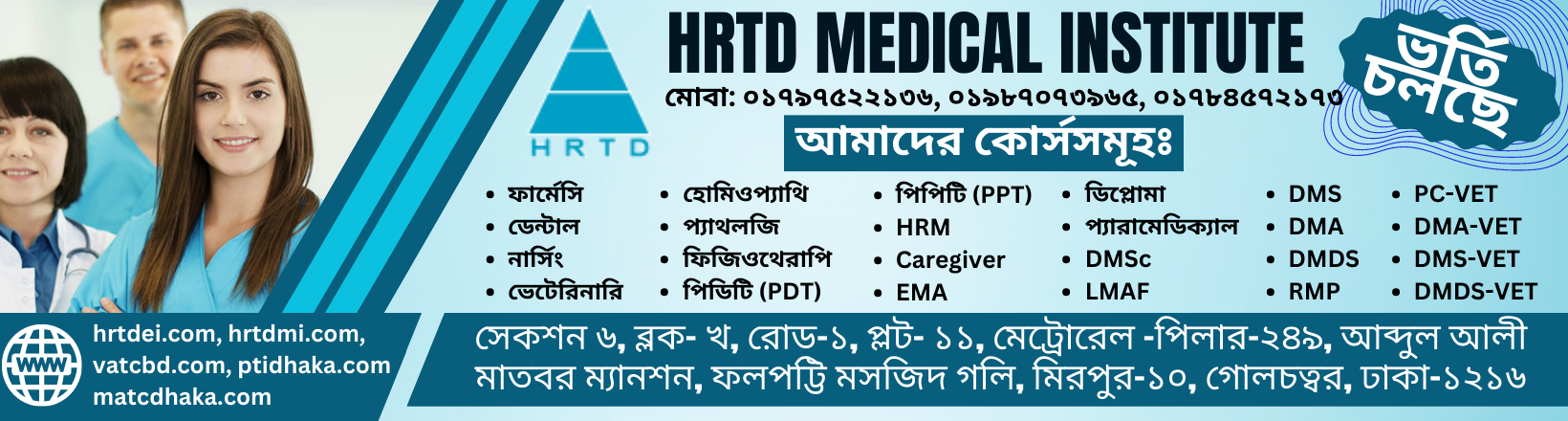
Pharmacy Course 6 Months HRTD Medical Institute, Abdul Ali Madbor Mansion, Folpotty Mosjid Goli (Bitul Mamur Jame Mosjid Goli), Plot No. 11, Metro Rail Piller No. 249, Mirpur 10 Golchattar, Dhaka.
Document for Pharmacy Course 6 Months
Pharmacy Course 6 Months for HRTD Medical Institute Photocopy of Certificate, Photocopy of NID, Passport Size Photo 4 Pcs. Without NID, a Birth Certificate is allowed for an emergency case.
Admission Eligibility for Pharmacy Course 6 Months
Pharmacy Course 6 Months Admission Eligibility. Mobile Number. 01987073965. 01941123488, 01797522136. SSC or Equivalent/HSC/ Degree/ Masters from any Background (Science/ Arts/ Commerce/ Technical).
Class System for Pharmacy Course 6 Months
Class System for Pharmacy Course 6 Months in Dhaka : Weekly Class 3 hours. For Job holders 3 hours in a day. The option days are Friday Morning Shift from 9:00 AM to 12:00 PM, Friday Evening Shift from 3:00 PM to 6:00 PM, Monday Morning Shift from 9:00 AM to 12:00 PM, Monday Evening Shift from 3:00 PM to 6:00 PM. Saturday Morning Shift from 10am to 1 Pm, Evening Shift from 3 pm to 6 pm.
For Regular Students Saturday 1 hour, Monday 1 hour, and Friday 1 hour. Morning Shift From 9:00 AM to 12:00 PM, and Evening Shift From 3:00 PM to 6:00 PM.
Hostel Facilities in HRTD Medical Institute for Pharmacy Course 6 Months
Hostal & Meal Facilities
The Institute has hostel facilities for the students. Students can take a bed in the hostel.
Hostel Fee Tk 3000/- Per Month
Meal Charges Tk 3000/- Per Month. ( Approximately )
হোস্টাল ও খাবার সুবিধা
ইনস্টিটিউটে শিক্ষার্থীদের জন্য হোস্টেল সুবিধা রয়েছে। ছাত্ররা হোস্টেলে বিছানা নিতে পারে।
হোস্টেল ফি 3000/- টাকা প্রতি মাসে,
খাবারের চার্জ 3000/- টাকা প্রতি মাসে।(প্রায়)
Address of HRTD Medical Institute for Pharmacy Course 6 Months
আমাদের ঠিকানাঃ HRTD মেডিকেল ইন্সটিটিউট, আব্দুল আলী মাদবর ম্যানশন, সেকশন ৬, ব্লোক খ, রোড ১, প্লট ১১, মেট্রোরেল পিলার নাম্বার ২৪৯, ফলপট্টি মসজিদ গলি, মিরপুর ১০ গোলচত্ত্বর, ঢাকা ১২১৬ । মোবাইল ফোন নাম্বার ০১৭৯৭৫২২১৩৬, ০১৯৮৭০৭৩৯৬৫ ।
Our Address: HRTD Medical Institute, Abdul Ali Madbor Mansion, Section-6, Block- Kha, Road- 1, Plot- 11, Metro Rail Pilar No. 249, Falpatty Mosjid Goli, Mirpur-10 Golchattar, Dhaka 1216. Mobile Phone No. 01797522136, 01987073965.
Teachers For Pharmacy Course 6 Months
- Dr. Md. Sakulur Rahman, MBBS, CCD (BIRDEM), Course Director
- Dr. Sanjana Binte Ahmed, BDS, MPH, Assistant Course Director
- Dr. Tisha, MBBS, PGT Gyne, Assistant Course Director
- Dr. Suhana, MBBS, PGT Medicine
- Dr. Danial Hoque, MBBS,
- Dr. Tisha, MBBS
- Dr. Afrin Jahan, MBBS, PGT Medicine
- Dr. Ananna, MBBS
- Dr. Lamia Afroze, MBBS
- Dr. Amena Afroze Anu, MBBS, PGT Gyne, Assistant Course Director
- Dr. Farhana Antara, MBBS,
- Dr. Nazmun Nahar Juthi, BDS, PGT
- Dr. Farhana Sharna, MBBS
- Dr. Bushra, MBBS
- Dr. Turzo, MBBS
- Dr. Kamrunnahar Keya, BDS, PGT (Dhaka Dental College)
- Dr. Shamima, MBBS, PGT Gyne
- Dr. Alamin, MBBS
- Dr. Benzir Belal, MBBS
- Dr. Disha, MBBS
- Dr. Mahinul Islam, MBBS
- Dr. Tisha, MBBS, PGT Medicine
- Dr. Anika, MBBS, PGT
- Dr. Jannatul Ferdous, MBBS, PGT Gyne
- Dr. Jannatul Aman, MBBS, PGT
- Dr. Rayhan, BPT
- Dr. Abu Hurayra, BPT
- Dr. Sharmin Ankhi, MBBS, PGT Medicine
- Md. Monir Hossain, B Pharm, M Pharm
- Md. Monirul Islam, B Pharm, M Pharm
- Md. Feroj Ahmed, BSc Pathology, PDT Medicine
Practical class for Pharmacy Course 6 Months
- Heart Beat, Heart Rate
- Heart Sound, Pulse
- Blood Pressure, Hypertension, Hypotension
- First Aid Box
- Auscultation
- Inhaler, Rota haler
- Nebulizer
- Glucometer Blood Glucose
- Injection I/V
- Injection I/M
- Cleaning, Dressing, Bandaging
- Saline
- CPR
- Stitch
- Body Temperature
- Nasal Tube Gel, Hand Wash
- Blood Grouping
- Cyanosis, Dehydration Test, Edema Test
Total Subjects and total marks in Pharmacy Course 6 Months
Total 5 subjects and total 500 marks for Pharmacy Course 6 Months
1. Anatomy and Physiology =100
2. Pharmacology =100
3. Study and OTC Medicines =100
4. First Aid and Antimicrobial Drugs =100
5. Pharmacology-2 =100
Our Location In HRTD Medical Institute for Pharmacy Course 6 Months
HRTD Medical Institute, Abdul Ali Madbor Mansion, Section-6, Block-kha, Road-1, Plot-11, Metro Rail Pilar No-249, Falpatty Mosjid Goli, Mirpur-10 Golchattar, Dhaka-1216, Mobile No- 01797522136.
Anatomy and Physiology of Pharmacy Course 6 Months
Anatomy and Physiology is an important subject for medical science. The study of Body Structure and its functions is Anatomy and Physiology. The systems of the Human Body are the Nervous System, Digestive System, Respiratory System, Cardiovascular System, Skeletal System, Muscular System, Endocrine System, Immune System, Lymphatic System, Covering System, and Urinary System.
চিকিৎসা বিজ্ঞানের জন্য অ্যানাটমি এবং ফিজিওলজি একটি গুরুত্বপূর্ণ বিষয়। দেহ গঠন এবং এর কার্যকারিতা অধ্যয়নের জন্য অ্যানাটমি এবং ফিজিওলজি ব্যবহৃত হয়। মানবদেহের সিস্টেমগুলি হল স্নায়ুতন্ত্র, পাচনতন্ত্র, শ্বাসযন্ত্র, হৃদযন্ত্র, কঙ্কালতন্ত্র, পেশীতন্ত্র, অন্তঃস্রাবী ব্যবস্থা, রোগ প্রতিরোধ ব্যবস্থা, লিম্ফ্যাটিক সিস্টেম, আবরণ ব্যবস্থা এবং মূত্রতন্ত্র।
Anatomy and physiology (A&P) are the foundational sciences of the body: Anatomy studies the body’s structures and their physical relationships (the “what & where”), while Physiology studies how those structures function (the “how & why”). Together, they explain life, from atoms to organ systems, focusing on how the body maintains balance (homeostasis) through interconnected systems like cardiovascular, nervous, and respiratory. A key principle is the complementarity of structure and function: form dictates function, meaning the shape of a part enables its job, like heart chambers pumping blood.
অ্যানাটমি এবং ফিজিওলজি (A&P) হল শরীরের মৌলিক বিজ্ঞান: অ্যানাটমি শরীরের গঠন এবং তাদের শারীরিক সম্পর্ক (“কী এবং কোথায়”) অধ্যয়ন করে, অন্যদিকে ফিজিওলজি অধ্যয়ন করে কিভাবে এই কাঠামোগুলি কাজ করে (“কিভাবে এবং কেন”)। একসাথে, তারা পরমাণু থেকে শুরু করে অঙ্গ সিস্টেম পর্যন্ত জীবনকে ব্যাখ্যা করে, কার্ডিওভাসকুলার, স্নায়বিক এবং শ্বাসযন্ত্রের মতো আন্তঃসংযুক্ত সিস্টেমের মাধ্যমে শরীর কীভাবে ভারসাম্য (হোমিওস্ট্যাসিস) বজায় রাখে তার উপর দৃষ্টি নিবদ্ধ করে। একটি মূল নীতি হল গঠন এবং কার্যকারিতার পরিপূরকতা: ফর্ম কার্যকারিতা নির্দেশ করে, যার অর্থ একটি অংশের আকৃতি তার কাজকে সক্ষম করে, যেমন হৃদপিণ্ডের প্রকোষ্ঠগুলি রক্ত পাম্প করে।
Pharmacology-1 of Pharmacy Course 6 Months
The study of Drugs and Medicine is called Pharmacology. Drugs are chemicals that can react with cells, tissues, and body organs. Common Groups of Drugs are Pain Killer Drugs, Anti Ulcer Drugs, Anti Vomiting Drugs, Anti Viral Drugs, Laxative Drugs, Motility Drugs and Antimotility Drugs, Bronchodilator Drugs, Antibiotic Drugs, Anti Fungal Drugs, Anti Thrombotic Drugs, Anti Protozoal Drugs, Anthelmintic Drugs, Anti Hypertensive Drugs, Beta Blocker Drugs, Calcium Channel Blocker Drugs, ACE Inhibitor Drugs, Analgesic Drugs, Antipyretic Drugs, Steroid Drugs, NSAID Drugs, CNS Drugs, Neuropathic Pain Keller Drugs, Spasmodic Drugs, etc.
ওষুধ ও ঔষধের অধ্যয়নকে ফার্মাকোলজি বলা হয়। ওষুধ হল এমন রাসায়নিক পদার্থ যা কোষ, টিস্যু এবং শরীরের অঙ্গগুলির সাথে প্রতিক্রিয়া করতে পারে। ওষুধের সাধারণ গ্রুপগুলি হল ব্যথানাশক ওষুধ, আলসার-বিরোধী ওষুধ, বমি-বিরোধী ওষুধ, ভাইরাস-বিরোধী ওষুধ, জোলাপ-সংক্রান্ত ওষুধ, গতিশীলতা-সংক্রান্ত ওষুধ এবং গতি-প্রতিরোধী ওষুধ, ব্রঙ্কোডাইলেটর ওষুধ, অ্যান্টিবায়োটিক ওষুধ, ছত্রাক-বিরোধী ওষুধ, থ্রম্বোটিক ওষুধ, প্রোটোজোয়াল ওষুধ, অ্যান্থেলমিন্টিক ওষুধ, হাইপারটেনসিভ ওষুধ, বিটা ব্লকার ওষুধ, ক্যালসিয়াম চ্যানেল ব্লকার ওষুধ, এসিই ইনহিবিটর ওষুধ, ব্যথানাশক ওষুধ, অ্যান্টিপাইরেটিক ওষুধ, স্টেরয়েড ওষুধ, এনএসএআইডি ওষুধ, সিএনএস ওষুধ, নিউরোপ্যাথিক পেইন কেলার ওষুধ, স্প্যাসমডিক ওষুধ ইত্যাদি।
Pharmacology is the scientific study of drugs, how they interact with living systems (like the human body) to produce effects, and how the body processes them (absorption, distribution, metabolism, excretion). It covers drug discovery, development, mechanisms, uses, and toxicology, aiming to improve health by fighting disease and understanding adverse effects, involving areas like pharmacokinetics (what the body does to the drug) and pharmacodynamics (what the drug does to the body).
ফার্মাকোলজি হলো ওষুধের বৈজ্ঞানিক অধ্যয়ন, কীভাবে তারা জীবন্ত ব্যবস্থার (যেমন মানবদেহ) সাথে প্রভাব তৈরির জন্য মিথস্ক্রিয়া করে এবং শরীর কীভাবে সেগুলি প্রক্রিয়া করে (শোষণ, বিতরণ, বিপাক, মলত্যাগ)। এটি ওষুধ আবিষ্কার, বিকাশ, প্রক্রিয়া, ব্যবহার এবং বিষবিদ্যাকে অন্তর্ভুক্ত করে, যার লক্ষ্য রোগের বিরুদ্ধে লড়াই করে এবং প্রতিকূল প্রভাবগুলি বোঝার মাধ্যমে স্বাস্থ্যের উন্নতি করা, যার মধ্যে ফার্মাকোকাইনেটিক্স (শরীর ওষুধের সাথে কী করে) এবং ফার্মাকোডাইনামিক্স (ওষুধ শরীরের সাথে কী করে) এর মতো ক্ষেত্রগুলি জড়িত।
Study of OTC and Medicine of Pharmacy Course 6 Months
The study of Over-The-Counter (OTC) and prescription medicines is a fascinating and crucial area within healthcare education, public health policy, and general consumer knowledge. It delves into the distinctions between medications deemed safe for self-administration and those requiring professional oversight, exploring how different people, including future healthcare professionals, understand and utilize these powerful substances in their daily lives. This field is highly relevant in a world where self-care is increasingly common and individuals often make independent decisions about treating minor ailments.
ভার-দ্য-কাউন্টার (ওটিসি) এবং প্রেসক্রিপশন ওষুধের অধ্যয়ন স্বাস্থ্যসেবা শিক্ষা, জনস্বাস্থ্য নীতি এবং সাধারণ ভোক্তা জ্ঞানের মধ্যে একটি আকর্ষণীয় এবং গুরুত্বপূর্ণ ক্ষেত্র। এটি স্ব-প্রশাসনের জন্য নিরাপদ বলে বিবেচিত ওষুধ এবং পেশাদার তত্ত্বাবধানের প্রয়োজন এমন ওষুধের মধ্যে পার্থক্যগুলি অনুসন্ধান করে, ভবিষ্যতের স্বাস্থ্যসেবা পেশাদার সহ বিভিন্ন ব্যক্তিরা তাদের দৈনন্দিন জীবনে এই শক্তিশালী পদার্থগুলি কীভাবে বোঝেন এবং ব্যবহার করেন তা অন্বেষণ করে। এই ক্ষেত্রটি এমন একটি বিশ্বে অত্যন্ত প্রাসঙ্গিক যেখানে স্ব-যত্ন ক্রমবর্ধমানভাবে সাধারণ এবং ব্যক্তিরা প্রায়শই ছোটখাটো রোগের চিকিৎসার বিষয়ে স্বাধীন সিদ্ধান্ত নেন।
Understanding the nuances of the “OTC and medicine subject” requires appreciating the careful regulatory balance between accessibility and safety, as well as the real-world implications of medication use and misuse.
Key Aspects of Studying OTC and Medicine Subjects for Pharmacy Course 6 Months
The core of this subject area revolves around several key themes, all aimed at promoting effective treatment while minimizing harm.
- Classification and Regulation: A primary focus is differentiating between OTC medicines and Prescription-Only Medicines (POMs). OTC drugs are regulatory-approved for consumer self-diagnosed conditions because they have a wide safety margin, are unlikely to be habit-forming, and their labeling provides adequate directions for safe use. In contrast, POMs are restricted because they may be potentially harmful if used without professional supervision, require a specific diagnosis, or have complex administration protocols. Regulatory bodies, such as the FDA in the U.S., carefully scrutinize medications before allowing them to switch from prescription to OTC status.
- Knowledge, Attitudes, and Practices (KAP): A significant body of research studies the “KAP” of the general public and healthcare students regarding OTC use. These studies consistently find that while OTC medications are widely used for common ailments like headaches, fever, and minor gastric issues, a general lack of understanding about potential risks, side effects, and drug interactions persists. This lack of knowledge can lead to problematic practices such as exceeding recommended dosages, using expired medication, or inappropriate use of antibiotics.
- Responsible Self-Medication: The concept of “responsible self-medication,” as promoted by the World Health Organization (WHO), is an important part of the study. This involves using medications appropriately for self-recognized conditions, following instructions diligently, and knowing when a condition warrants professional medical consultation. Educational initiatives often aim to improve public knowledge to facilitate safe self-care practices.
- Misuse, Abuse, and Dependency: A darker, but vital, part of the subject is the potential for misuse, abuse, and dependency, even with seemingly benign OTC products. Certain cough and cold medicines containing dextromethorphan, for example, can produce hallucinogenic effects in large doses, especially among young adults. Opioid-based painkillers, whether prescribed or somehow obtained over-the-counter, also carry significant addiction risks. Studying this area involves recognizing risk factors and developing support pathways for individuals who become dependent on these substances.
Why is this study important of Pharmacy Course 6 Months
The study of OTC and medicine is not merely academic; it has profound public health implications:
- Public Health and Safety: By understanding usage patterns and knowledge gaps, public health officials can develop targeted education campaigns and implement better regulations to prevent harm.
- Healthcare Economics: Appropriate use of OTC drugs for minor ailments can decrease the burden on healthcare systems by reducing doctor visits and associated costs. However, misuse can increase costs due to adverse reactions or delayed diagnosis.
- Empowering Patients: Educating consumers about safe OTC use empowers them to manage their own health effectively and confidently.
In conclusion, the “study of OTC and medicine subject” is a dynamic and essential field that bridges pharmacology, public health, psychology, and regulatory science. It is an ongoing endeavor to ensure that medications, whether over-the-counter or prescription, are used safely, effectively, and responsibly by everyone, from the general population in Dhaka to medical students around the globe. Continued research and education are crucial in navigating the complex world of medication use and fostering a culture of informed self-care
First aid 1 & 2 of Pharmacy Course 6 Months
First Aid 1 & 2 are sequential training levels, with Level 1 (Basic) covering essential life-saving skills like CPR, bleeding control, fractures, and burns for everyday emergencies, while Level 2 (Intermediate) builds on this with more detailed care for conditions like severe bleeding, shock, poisoning, and spinal injuries, plus specific scenarios like drowning, heart attacks, and advanced bandaging/splinting, preparing you for more complex situations before professional medical help arrives.
First Aid Level 1 (Basic Life Support)
- Focus: Fundamental skills for common emergencies.
- Skills Taught: Scene assessment, CPR, choking (adult/child), bleeding control, burns, shock, fainting, basic fracture care, and vital signs.
- Best For: Low-risk environments like offices, schools, and general staff.
First Aid Level 2 (Intermediate Life Support)
- Focus: Building on Level 1 with more detailed & advanced care.
- Skills Taught: Advanced wound/shock management, splinting, managing multiple injuries, infant CPR, specific illnesses (asthma, epilepsy, stroke), drowning, severe bleeding, burns, poisonings, and patient history taking.
- Best For: Higher-risk workplaces where more complex incidents are possible, often a combined 1 & 2 course.
Key Differences for Pharmacy Course 6 Months
- Depth: Level 2 goes deeper into theory and practical skills than Level 1.
- Complexity: Level 2 addresses more severe or complex conditions and scenarios.
- Progression: They are designed to be taken in order, with Level 2 expanding on Level 1 knowledge.
Antimicrobial Drugs for Pharmacy Course 6 Months
The subject of Antimicrobial Drugs covers medicines like antibiotics, antivirals, antifungals, and antiparasitics, used to treat infections by killing or stopping microbes (bacteria, viruses, fungi, parasites). Key aspects include their classification (by microbe target, e.g., antibiotics for bacteria, antivirals for viruses), mechanisms of action (e.g., bactericidal vs. bacteriostatic), selective toxicity (killing microbes without harming hosts), and the critical global threat of Antimicrobial Resistance (AMR) due to misuse, making infections harder to treat.
Core Concepts of Antimicrobial drugs for Pharmacy Course 6 Months
- Definition: Agents that inhibit or kill microorganisms like bacteria, viruses, fungi, and parasites.
- Types:
- Antibiotics: Target bacteria (e.g., penicillin, vancomycin).
- Antivirals: Target viruses (e.g., acyclovir).
- Antifungals: Target fungi (e.g., ketoconazole).
- Antiparasitics: Target parasites (e.g., mefloquine, niclosamide).
- Mechanisms: How they work, such as inhibiting cell wall synthesis or folic acid production, determining if they kill (bactericidal) or stop growth (bacteriostatic).
- Selective Toxicity: The principle of targeting microbial cells while sparing host (human/animal) cells, a fundamental goal in drug design.
Key Issues & Challenges
- Antimicrobial Resistance (AMR): Microbes evolve to resist drugs, making infections untreatable and threatening modern medicine (surgery, chemotherapy).
- Development Pipeline: A decline in discovering new antimicrobials exacerbates the AMR crisis.
Importance of Antimicrobial drugs for Pharmacy Course 6 Months
- They are essential for treating infectious diseases and performing life-saving procedures.
- The subject involves understanding drug action, resistance mechanisms, and developing new agents to combat evolving pathogen
Pharmacology-2 of Pharmacy Course 6 Months
Pharmacology-2 typically covers Autonomic Nervous System Drugs, Cardiovascular Drugs, Respiratory Drugs, Gastrointestinal Drugs, Hormonal Drugs, Chemotherapy (Antimicrobials, Antifungals, Antivirals), CNS Drugs, and further delves into detailed Pharmacokinetics (ADME – Absorption, Distribution, Metabolism, Excretion) and Pharmacodynamics (Drug Actions/Effects), focusing on drug classes, mechanisms, uses, adverse effects, and rational prescribing principles for specific body systems, building on foundational knowledge from Pharmacology-1.
Key Subject Areas in Pharmacology-2 of Pharmacy Course 6 Months
- Autonomic Nervous System Drugs: Sympathomimetics, Parasympathomimetic, Anticholinergics, etc..
- Cardiovascular Drugs: Anti-hypertensives, Anti-anginas, Anti-arrhythmics, Diuretics, Anticoagulants, etc..
- Respiratory Drugs: Bronchodilators, Anti-asthmatics, Cough suppressants.
- Gastrointestinal Drugs: Antacids, Anti-emetics, Laxatives, Anti-ulcer drugs.
- Hormonal Drugs: Thyroid drugs, Oral contraceptives, Steroids, Insulin & anti-diabetics.
- Chemotherapy Agents:
- Antimicrobials: Beta-lactams (Penicillins, Cephalosporins), Aminoglycosides, Tetracyclines, Macrolides, Quinolones, Sulphonamides, etc..
- Antifungals & Anti-TB drugs.
- Antiviral drugs.
- Central Nervous System (CNS) Drugs: Analgesics, Anesthetics, Anti-epileptics, Antidepressants, etc..
- Advanced Pharmacokinetics & Pharmacodynamics: Deeper dive into ADME, drug interactions, adverse drug reactions (ADRs), and rational prescribing.
Focus Areas for Pharmacology-2 of Pharmacy Course 6 Months
- Systemic Approach: Drugs are typically grouped by the body system they affect (e.g., cardiovascular, respiratory).
- Clinical Relevance: Emphasis on rational drug use, side effects, drug interactions, and clinical application.
- Continuation: Builds upon general principles learned in Pharmacology-1 (e.g., basic ADME, drug administratio