 MATCDHAKA – Medical Assistant Training Centre in Dhaka Pharmacy, Veterinary, Dental, Nursing, Pathology, Physiotherapy and Homeopathy Training Institute in Dhaka



LMAF Courses in Bangladesh are LMAF 6 Months, LMAF 1 Year, and LMAF 2 Years
LMAF Courses in Bangladesh. Mobile No. 01987-073965, 01797-522136. LMAF 6 Months Course Fee Tk 30,500/-, LMAF 1 Year Course Fee Tk 52500/-, and LMAF 2 Years Course Fee Tk 92500/-. 6 Months LMAF Contains 5 Subjects, 1 Year LMAF Contains 10 Subjects and 2 Years LMAF Contains 18 Subjects.
LMAF Course 6 Months in Bangladesh
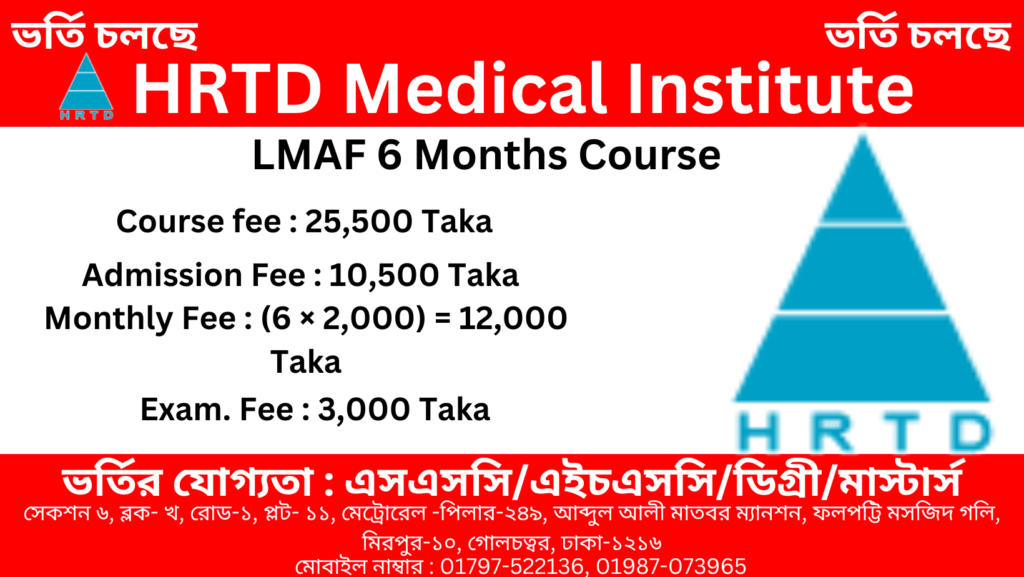
LMAF Course 6 Months: Mobile Number 01987-073965, 01797-522136. The shortest LMAF Course is 6 Months LMAF Course. This course contains 5 subjects. The subjects are Human Anatomy & Physiology, Pharmacology-1, First Aid & Treatment, Study of OTC Drugs, and Hematology & Pathology. This shortest LMAF Course is for the primary treatment of rural patients in Bangladesh. Total course fee Tk 30,500.
LMAF Course 1 Year in Bangladesh
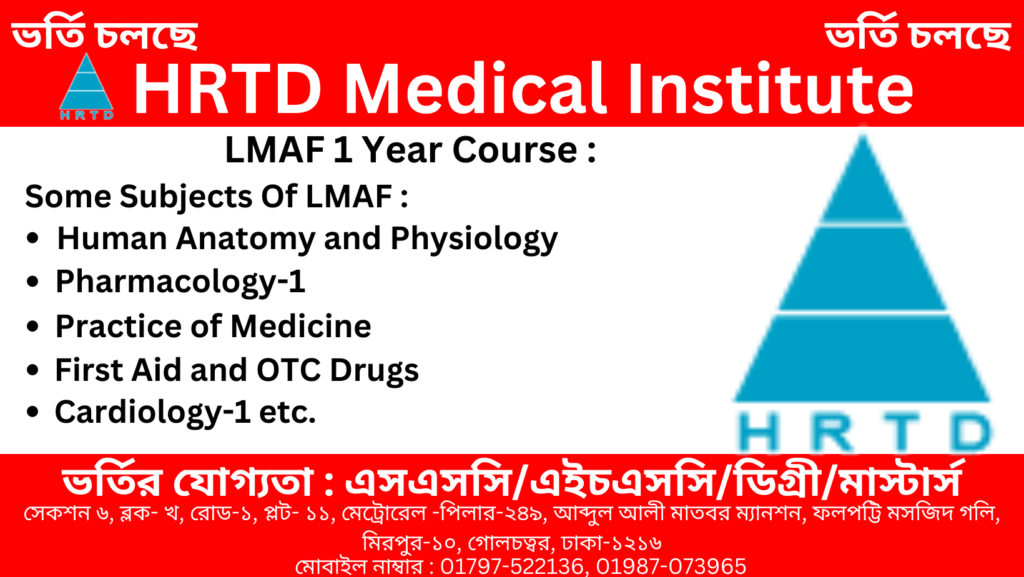
LMAF Courses in Bangladesh LMAF Course 1 Year: Mobile Number 01987-073965, 01797-522136. The short LMAF Course is 1 Year LMAF Course. This course contains 10 subjects. The subjects are Human Anatomy & Physiology, Pharmacology-1, First Aid & Treatment, Study of OTC Drugs, and Hematology & Pathology. This short LMAF Course is for the primary treatment of rural patients in Bangladesh. Total course fee Tk 52500 including admission fee, monthly fee, and exam fee.
LMAF Course 2 Years in Bangladesh
LMAF Course 2 Years: Mobile Number 01987-073965, 01797-522136. This long course of LMAF 2 Years contains 18 subjects. The subjects are Human Anatomy & Physiology, Pharmacology-1, First Aid & Treatment, Study of OTC Drugs, and Hematology & Pathology, and 13 more subjects. This Medium type of LMAF Course is for the primary treatment of patients in Bangladesh. Total course fee Tk 92500 including admission fee, monthly fee, and exam fee.
Practical classes for LMAF Courses in Bangladesh
Stethoscope, Blood Pressure, Body Temperature, pulse, IV-IM Injection, Canola, Saline Infusion, Inhaler, Rota Haler, Nebulizer, Cleaning, Dressing, Bandaging, Stitching, Glucometer, Fat Soluble & Water Soluble Vitamin, Blood grouping, CPR, Mouth wash, Blood sugar, Insulin (Diabetes).
Anatomy and Physiology for LMAF Courses in Bangladesh
LMAF Courses in Bangladesh. Anatomy and Physiology is an important subject for the LMAF Course. The study of Body Structure and its functions is Anatomy and Physiology. Here we discuss the systems of the Human Body and its Organs, Tissues, and Cells. The systems of the Human Body are the Nervous System, Digestive System, Respiratory System, Circulatory System or Cardiovascular System, Skeletal System, Muscular System, Endocrine System, Immune System, Lymphatic System, Integumentary System or Covering System, and Urinary System.
Anatomy and physiology (A&P) are the twin biological sciences: Anatomy studies the body’s structures (cells, tissues, organs, systems), while Physiology studies how these structures function and work together to sustain life, explaining the ‘how’ behind the ‘what’. A&P explores the body’s physical makeup (anatomy) and its processes (physiology) using principles from chemistry and physics, forming a foundational understanding for health, medicine, and life sciences.
Anatomy (Structure)
- Definition: The study of the body’s forms, parts, and their relationships, from microscopic levels (cells) to macroscopic (organs, systems).
- Examples: Identifying bones, muscles, organs, or the specific tissues within the heart.
Physiology (Function)
- Definition: The study of how body parts work, function, and interact to perform life processes.
- Examples: How the heart pumps blood, how kidneys form urine, or how nerves transmit signals.
The Connection: Structure Determines Function
- These fields are inseparable; a structure’s anatomy dictates its function, and understanding both provides a complete picture of the body.
- Example: The heart’s chambers (anatomy) allow it to pump blood efficiently (physiology).
Key Concepts & Systems for LMAF Courses in Bangladesh
- Systems-Oriented Approach: Studying major systems like the circulatory, nervous, digestive, respiratory, and musculoskeletal systems.
- Homeostasis: The body’s ability to maintain a stable internal environment (e.g., blood sugar, temperature).
- Feedback Loops: Mechanisms like negative (stabilizing) and positive (amplifying) feedback that regulate bodily functions.
Pharmacology for LMAF Courses in Bangladesh
The study of Drugs and Medicine is called Pharmacology. This subject is important for the LMAF Course. Drugs are chemicals that can react with cells, tissues, and organs of the body. Here we discuss group-wise drugs and their medicines. Common Groups of Drugs are Pain Killer Drugs, Anti Ulcer Drugs, Anti Vomiting Drugs, Anti Viral Drugs, Laxative Drugs, Motility Drugs and Antimotility Drugs, Bronchodilator Drugs, Antibiotic Drugs, Anti Fungal Drugs, Anti Thrombotic Drugs, Anti Protozoal Drugs, Anthelmintic Drugs, Anti Hypertensive Drugs, Beta Blocker Drugs, Calcium Channel Blocker Drugs, ACE Inhibitor Drugs, Hemostatic Drugs, Analgesic Drugs, Antipyretic Drugs, Steroid Drugs, NSAID Drugs, CNS Drugs, Neuropathic Pain Keller Drugs, Spasmodic Drugs, etc.
Pharmacology is the scientific study of drugs and their effects on living systems, covering how substances interact with the body (pharmacodynamics) and how the body processes them (pharmacokinetics: absorption, distribution, metabolism, excretion). It’s a research-focused field combining biology, chemistry, and medicine, aiming to discover new drugs, understand disease mechanisms, and develop treatments, distinct from pharmacy, which focuses on dispensing medications.
Key Areas of Study of LMAF Courses in Bangladesh
- Pharmacokinetics (PK): What the body does to the drug (ADME).
- Pharmacodynamics (PD): What the drug does to the body (mechanisms of action).
- Toxicology: The study of harmful effects of chemicals.
- Drug Discovery & Development: From molecular design to clinical trials.
Core Components of LMAF Courses in Bangladesh
- Molecular/Cellular Level: How drugs affect genes, cells, and tissues.
- Systems Level: How drugs impact organs and systems (e.g., nervous, cardiovascular).
- Therapeutic Use: How drugs treat diseases (e.g., infections, cancer, pain).
Career & Study Path of LMAF Courses in Bangladesh
- Focus: Research, innovation, and understanding drug action.
- Related Fields: Biochemistry, molecular biology, medicine, toxicology, biotechnology, medicinal chemistry.
- Career Paths: Pharmaceutical research, biotech industry, healthcare, further studies (MSc, PhD, Medicine).
What it’s NOT (vs. Pharmacy)
- Pharmacology: Research-focused, discovering & understanding drugs.
- Pharmacy: Practice-focused, dispensing & managing drug therapy for patients (M Pharm degrees often integrate this.
First Aid for LMAF Courses in Bangladesh
First Aid is an important subject for all courses. It is very important for the LMAF Training Course. Here we discuss Shock, Classifications of Shock, Causes of Shock, Stages of Shock, Clinical Features of Shock, Hypovolemic Shock, Cardiogenic Shock, Neurogenic Shock, Traumatic Shock, Burn Shock, Electric Shock, Psychogenic Shock, Anaphylactic Shock, First Aid of Shock, Management of Shock, First Aid of Cut, First of Snake Bite, First Aid of Accidental Injury, etc.
First aid is the immediate, initial care given to someone with an injury or sudden illness, aiming to preserve life, prevent worsening, and promote recovery until professional help arrives, ranging from applying bandages to minor cuts to performing CPR in emergencies, and requires assessing the scene for safety and the person’s responsiveness. Key steps involve checking for danger, response, calling emergency services (like 911), and providing care like controlling bleeding, managing burns, or assisting with choking, often using basic tools from a first aid kit.
Core Principles of First Aid for LMAF Courses in Bangladesh
- Scene Safety: Ensure the area is safe for you and the injured person before approaching.
- Call for Help: Activate emergency services (911/local number) for serious situations.
- Assess the Person: Check for responsiveness (shout-tap-shout) and signs of breathing.
- Consent: Ask for permission to help if the person is conscious.
- Protect Yourself: Use gloves and other PPE to avoid bodily fluids.
Common First Aid Situations & Actions of LMAF Courses in Bangladesh
- Minor Cuts/Scrapes: Clean with water, apply antiseptic, and bandage.
- Burns: Cool with water, cover loosely with sterile gauze, apply burn ointment if needed.
- Choking: Perform the Heimlich maneuver (abdominal thrusts) if trained.
- Severe Bleeding: Apply direct pressure with a clean cloth or gauze.
- CPR: Start chest compressions and rescue breaths if someone isn’t breathing and has no pulse.
- Shock: Lay the person down, raise their legs, keep them warm, and reassure them.
Essential First Aid Kit Items of LMAF Courses in Bangladesh
- Adhesive bandages, sterile gauze, tape
- Antiseptic wipes, antibiotic ointment
- Disposable gloves, pocket mask
- Cold packs, eye wash
- Scissors, tweezers
Importance
Proper first aid can be the difference between life and death, helping to stabilize a patient and improve outcomes until paramedics take over, so getting formal training (like CPR/AED) is highly recommended.
Study of OTC Drugs for LMAF Courses in Bangladesh
OTC is the short form of over-the-counter. That is OTC Drugs are over-the-counter drugs. The study of OTC Drugs is important for the LMAF Training Course. These Drugs can be sold or purchased without any prescription from Registered MBBS Doctors. These Drugs are Emergency and Safe for the patients. The study of OTC Drugs improves the quality of practice. Some OTC Drugs are Paracetamol, Albendazole, Ascorbic Acid, Calcium, Multivitamins, Vitamin B Complex, Omeprazole, Oral Rehydration Salt, Salbutamol, Mebendazole, Neomycin, Gentamycin, Bacitracin, etc.
Studying Over-the-Counter (OTC) drugs involves looking at their common uses (pain, fever, GI issues), popular types (NSAIDs, antacids, cough meds), reasons for use (convenience, poor healthcare access), who uses them (males, lower income), and the prevalence of self-medication, often revealing high usage, particularly of antibiotics and NSAIDs, signaling needs for regulation and education, especially in regions like Bangladesh and India where self-care with OTCs is widespread.
Key Areas of Study for LMAF Courses in Bangladesh
- Prevalence & Patterns: How often are OTCs used, and for what symptoms (fever, pain, cold/cough, GI issues)?.
- Common Drugs: What specific types are popular (NSAIDs like ibuprofen/aspirin, antacids, cough suppressants, antibiotics, antihistamines)?.
- Motivations: Why do people choose OTCs over prescription meds (accessibility, cost, convenience, perceived minor illness)?.
- Demographics: Who uses them more (gender, education, income, student status, healthcare access)?.
- Risks & Misuse: Identifying issues like antibiotic misuse (leading to resistance) and NSAID overuse.
- Knowledge & Attitudes: Understanding public awareness, attitudes, and practices related to OTCs.
Common Findings from Studies of LMAF Courses in Bangladesh
- High Self-Medication: Very common, driven by accessibility and convenience.
- Top Choices: Pain relievers (NSAIDs) and antacids are frequently used.
- Antibiotic Concerns: Significant misuse of antibiotics for self-treatment is a major public health issue.
- Predictors: Lower income, poor perceived access to healthcare, and male gender often correlate with higher OTC use.
Why Study OTC drugs of LMAF Courses in Bangladesh
- To improve public health education on safe usage.
- To develop better regulatory controls.
- To understand self-care practices, especially in low-to-middle-income countries (LMICs).
Teachers for LMAF Courses in Bangladesh
Teachers for LMAF Course in Bangladesh :
Dr. Sakulur Rahman, MBBS, CCD, PGT
Dr. Suhana, MBBS, PGT
Dr. Laila, MBBS, PGT
Dr. Shamima, MBBS, PGT
Dr. Disha, MBBS, FCPS
Dr. Tisha, MBBS, PGT Medicine
Dr. Mahinul Islam, MBBS,
Dr. Turzo, MBBS, FCPS
Dr. Juthi, BDS, PGT
Dr. Sanjana, BDS, MPH
Dr. Keya, BDS, PGT
Other Village Doctor for LMAF Courses in Bangladesh
Our village doctors courses are RMP course 6Month, DMA course 1Year, DMA course 2Year, DMS course 1Year, DMS course 2 Year, Paramedical course 1Year, Paramedical 2 Years.