 MATCDHAKA – Medical Assistant Training Centre in Dhaka Pharmacy, Veterinary, Dental, Nursing, Pathology, Physiotherapy and Homeopathy Training Institute in Dhaka




DMA Courses in Bangladesh are available in 4 types
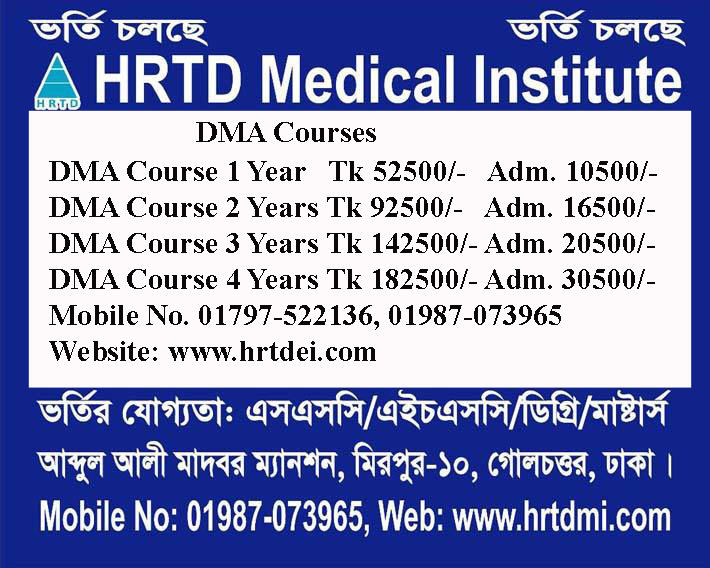
DMA Courses in Bangladesh. Mobile No. 01987-073965, 01797-522136. DMA Course 1 Year, DMA Course 2 Years, DMA Course 3 Years, and DMA Course 4 Years. DMA 1 Years Course Fee Tk 52500/-, DMA 2 Years Course Fee Tk 92500/-, DMA 3 Years Course Fee Tk 142500/-, and DMA 4 Years Course Fee Tk 182500/-.
DMA Course 1 Year in Bangladesh details
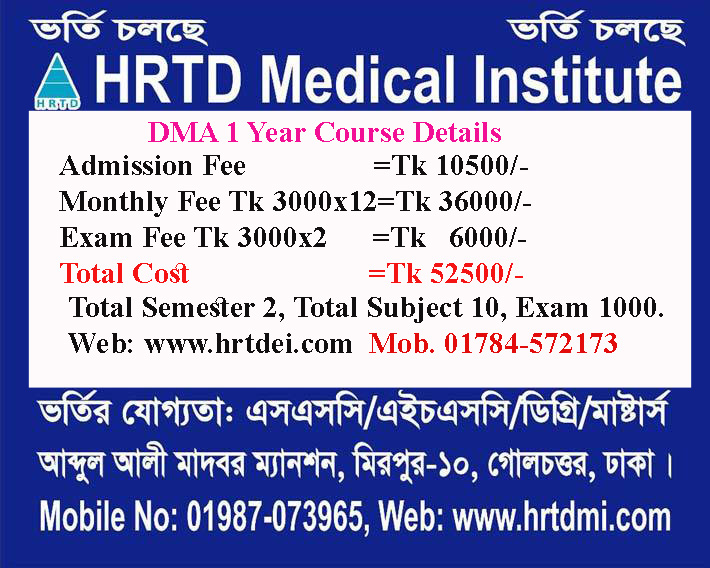
DMA Course 1 Year: Diploma Medical Assistant ( DMA 1 Year). This course contains 10 subjects. The subjects are Human Anatomy & Physiology, Pharmacology-1, Practice of Medicine, Hematology, Pathology, Microbiology, etc. The total course fee for this one-year course is Tk 52500 only. Payment system: Admission fee Tk 10500, Monthly fee Tk 3000, and exam fee. This course is divided into two semesters. The first semester contains 5 subjects and the second semester contains 5 subjects.
DMA Course 2 Years in Bangladesh details
DMA Course 2 Years: Diploma Medical Assistant ( DMA 2 Years). This course contains 18 subjects. The subjects are Human Anatomy & Physiology, Pharmacology-1, Practice of Medicine, Hematology, Pathology, Microbiology, etc. The total course fee for this one-year course is Tk 92500 only. Payment system: Admission fee Tk 16500, Monthly fee Tk 3000, and exam fee. This course is divided into 4 semesters. The first semester contains 5 subjects and the second semester contains 5 subjects. The third semester contains 4 subjects and 4th semester contains 4 subjects.
DMA Course 3 Years in Bangladesh details
DMA Course 3 Years: Diploma Medical Assistant ( DMA 3 Years). This course contains 24 subjects. The subjects are Human Anatomy & Physiology, Pharmacology-1, Practice of Medicine, Hematology, Pathology, Microbiology, etc. The total course fee for this one-year course is Tk 142500 only. Payment system: Admission fee Tk 20500, Monthly fee Tk 3000, and exam fee. This course is divided into 6 semesters. The first semester contains 5 subjects and the second semester contains 5 subjects. The third semester contains 4 subjects and 4th semester contains 4 subjects. The 5th semester contains 3 subjects and the 6th semester contains 3 subjects.
DMA Course 4 Years in Bangladesh details
DMA Courses 1 Year, 2 Years 3 Years, and 4 Years: Diploma Medical Assistant ( DMA 4 Years). This course contains 30 subjects. The subjects are Human Anatomy & Physiology, Pharmacology-1, Practice of Medicine, Hematology, Pathology, Microbiology, etc. If you want to complete DMA Courses in Bangladesh, please, contact with us.
The total course fee for this one-year course is Tk 182500 only. Payment system: Admission fee Tk 30500, Monthly fee Tk 3000, and exam fee. If you want to complete DMA Courses in Bangladesh, please, contact with us.
This course is divided into 8 semesters. The first semester contains 5 subjects and the second semester contains 5 subjects. The third semester contains 4 subjects and 4th semester contains 4 subjects. The 5th semester contains 3 subjects and the 6th semester contains 3 subjects. If you want to complete DMA Courses in Bangladesh, please, contact with us.
The 7th semester of the DMA Courses in Bangladesh contains 3 subjects and the 8th semester contains 3 subjects. If you want to complete DMA Courses in Bangladesh, please, contact with us.
Location for DMA Courses in Bangladesh
Location for DMA Courses in Bangladesh: HRTD Medical Institute, Section-6, Block-Kha, Road-1, Plot-11, Metro Rail Piller Number 249, Mirpur-10 Golchattar, Dhaka-1216. Mobile Phone Number 01797522136, 01987073965.
Document for Admission DMA Courses in Bangladesh
2 Years DMA Course Photocopy of Certificate, Photocopy of NID, Passport Size Photo 4 Pcs. Without NID, a Birth Certificate is allowed for an emergency case.
Admission Eligibility for DMA Courses in Bangladesh
2 Years DMA Course Admission Eligibility. Mobile Number. 01987073965. 01941123488, 01797522136. SSC or Equivalent/HSC/ Degree/Master’s from any Background (Science/ Arts/ Commerce/ Technical).
Class System for DMA Courses in Bangladesh
Class System for DMA Courses in Bangladesh: Weekly Class 3 hours. For jobholders, 3 hours a day. The option days are Friday Morning Shift from 9:00 AM to 12:00 PM, Friday Evening Shift from 3:00 PM to 6:00 PM, Monday Morning Shift from 9:00 AM to 12:00 PM, and Monday Evening Shift from 3:00 PM to 6:00 PM. Saturday Morning Shift from 10am to 1 Pm, Evening Shift from 3 pm to 6 pm.
For Regular Students, Saturday 1 hour, Monday 1 hour, and Friday 1 hour. Morning Shift From 9:00 AM to 12:00 PM, and Evening Shift From 3:00 PM to 6:00 PM.
Hostel Facilities in HRTD Medical Institute for DMA Courses in Bangladesh
Hostel & Meal Facilities
The Institute has hostel facilities for the students. Students can take a bed in the hostel.
Hostel Fee Tk 3000/- Per Month
Meal Charges Tk 3000/- Per Month. ( Approximately )
হোস্টাল ও খাবার সুবিধা
ইনস্টিটিউটে শিক্ষার্থীদের জন্য হোস্টেল সুবিধা রয়েছে। ছাত্ররা হোস্টেলে বিছানা নিতে পারে।
হোস্টেল ফি 3000/- টাকা প্রতি মাসে,
খাবারের চার্জ 3000/- টাকা প্রতি মাসে।(প্রায়)
Address of HRTD Medical Institute for DMA Courses in Bangladesh
আমাদের ঠিকানাঃ HRTD মেডিকেল ইন্সটিটিউট, আব্দুল আলী মাদবর ম্যানশন, সেকশন ৬, ব্লোক খ, রোড ১, প্লট ১১, মেট্রোরেল পিলার নাম্বার ২৪৯, ফলপট্টি মসজিদ গলি, মিরপুর ১০ গোলচত্ত্বর, ঢাকা ১২১৬ । মোবাইল ফোন নাম্বার ০১৭৯৭৫২২১৩৬, ০১৯৮৭০৭৩৯৬৫ ।
Our Address: HRTD Medical Institute, Abdul Ali Madbor Mansion, Section-6, Block- Kha, Road- 1, Plot- 11, Metro Rail Pilar No. 249, Falpatty Mosjid Goli, Mirpur-10 Golchattar, Dhaka 1216. Mobile Phone No. 01797522136, 01987073965.
Practical class for DMA Courses in Bangladesh
- Heart Beat, Heart Rate
- Heart Sound, Pulse
- Blood Pressure, Hypertension, Hypotension
- First Aid Box
- Auscultation
- Inhaler, Rota haler
- Nebulizer
- Glucometer Blood Glucose
- Injection I/V
- Injection I/M
- Cleaning, Dressing, Bandaging
- Saline
- CPR
- Stitch
- Body Temperature
- Nasal Tube Gel ,Hand Wash
- Blood Grouping
- Cyanosis, Dehydration Test, Edema Test
Anatomy & Physiology for DMA Courses in Bangladesh
Anatomy & Physiology is very important subjects for DMA course in Bangladesh. The study of body structure & its function is human Anatomy, Such as heart, lungs, kidney, liver, brain, skeleton, skin, muscle, fat, & blood. There are many systems of human body the Digestive system, Respiratory system, Cardiovascular system, Muscular system, Skeletal system, Reproductive system, Endocrine system, Nervous system, Urinary system, Immune system, Lymphatic system & Covering system

Anatomy and physiology are the two cornerstone disciplines of the biological and medical sciences, providing the essential roadmap for understanding how the human body is built and how it functions in daily life. While they are distinct fields of study—one focusing on the “what” and “where” and the other on the “how”—they are inextricably linked through the principle of complementarity: a structure’s form is inherently designed to facilitate its specific function.
Whether you are a student preparing for a career in healthcare or simply a curious individual, grasping these concepts is vital for making informed decisions about nutrition, medications, and general wellness.
The Difference Between Anatomy and Physiology
To navigate this vast field, it is helpful to first distinguish between the two primary areas of study:
- Anatomy (The Science of Structure): Derived from the Greek word anatomē, meaning “dissection,” anatomy is the study of the internal and external physical structures of organisms and their physical relationships. It identifies where an organ is located, what it is made of (e.g., tissues, cells), and what it looks like.
- Physiology (The Science of Function): This branch focuses on the mechanisms and chemistry behind the body’s activities. It asks how these structures work together to perform tasks like pumping blood, digesting food, or transmitting electrical signals in the brain.
Key Subdisciplines and Branches
Both fields are divided into specialized branches to allow for more detailed investigation:
Branches of Anatomy DMA Courses in Bangladesh
- Gross Anatomy: The study of structures that are large enough to be seen by the naked eye, often through dissection.
- Microscopic Anatomy: Focuses on structures only visible under a microscope, including Cytology (the study of cells) and Histology (the study of tissues).
- Regional vs. Systemic Anatomy: Regional anatomy looks at specific areas (like the head or thorax), while systemic anatomy studies discrete organ systems (like the nervous or skeletal systems).
Branches of Physiology DMA Courses in Bangladesh
- Cellular and Molecular Physiology: Investigates the functions of individual cells and the chemical signals that drive them.
- Pathophysiology: The study of how the body’s normal functions are disrupted by disease or injury.
- Comparative Physiology: Compares how different species perform similar functions, providing insights into evolution and adaptation.
Core Principles of Human Life
Understanding anatomy and physiology in 2025 involves more than just memorizing body parts; it requires understanding the fundamental “Big Ideas” that govern our existence:
- Homeostasis: This is the body’s ability to maintain a stable internal environment despite constant external changes. For example, the body regulates its own temperature and blood glucose levels through complex feedback loops.
- Levels of Organization: Life is organized hierarchically, beginning with the chemical level (atoms and molecules), moving to the cellular level, then to tissues, organs, organ systems, and finally the complete organism.
- Metabolism: This encompasses all chemical reactions in the body that produce and consume energy to sustain life.
- Complementarity of Form and Function: A core tenet stating that a structure’s physical shape allows it to perform its job. For example, the lungs have a vast surface area of thin-walled sacs (alveoli) specifically to maximize gas exchange.
The 11 Major Organ Systems
The human body is typically categorized into 11 interconnected systems, each with a unique set of roles:
- Integumentary System: Skin, hair, and nails that protect the body and regulate temperature.
- Skeletal System: Bones and joints that provide support and protection.
- Muscular System: Muscles that allow for movement and heat production.
- Nervous System: Brain, spinal cord, and nerves that act as the body’s control center.
- Endocrine System: Glands that secrete hormones to regulate growth and metabolism.
- Cardiovascular System: The heart and blood vessels that transport nutrients and oxygen.
- Respiratory System: Lungs and airways that facilitate the exchange of oxygen and carbon dioxide.
- Digestive System: Organs that break down food and absorb nutrients.
- Urinary System: Kidneys and bladder that filter waste and maintain fluid balance.
- Lymphatic/Immune System: Defends the body against infection and disease.
- Reproductive System: Organs responsible for producing offspring.
History and Modern Advancement
The study of anatomy has progressed from the early dissections of Herophilus, often called the “Father of Anatomy,” and the groundbreaking work of Andreas Vesalius in the 16th century. Today, field-leading tools like MRI (Magnetic Resonance Imaging) and CT scans allow us to visualize the living body in 3D without a single incision.
In summary, anatomy and physiology are dynamic, evolving fields that offer a “science of us”. By connecting microscopic chemical reactions to macroscopic body movements, they explain the remarkable resilience and complexity of human life. If you are looking to dive deeper, authoritative resources like Open Stix Anatomy and Physiology 2e provide comprehensive, free educational content.
Pharmacology for DMA Courses in Bangladesh
Pharmacology is an important subject in DMA Course in Bangladesh. The study of drugs knowledge & Medicine is called Pharmacology. Common groups of Drugs are Antiulcer drug, Antidiabetic drugs, Antihistamine drugs, Anti Inflammatory drugs, Antipyretic drugs, Anthelmintic drug, Antiprotozoa drugs, Anti bacteria drugs, NSAID drugs, Steroid drugs etc.
Pharmacology is the vast and multidisciplinary scientific branch of medicine and biology concerned with the study of drug action. At its core, it seeks to understand how chemical substances—whether naturally occurring, synthetic, or endogenous (produced within the body)—interact with living organisms to produce a biological effect. This field is not merely about identifying what a medicine does; it involves a meticulous investigation into the origin, physical and chemical properties, physiological effects, and biochemical mechanisms of every drug.
The importance of pharmacology cannot be overstated in modern healthcare. It acts as a bridge science, integrating knowledge from chemistry, physiology, and molecular biology to transform chemical compounds into life-saving therapies. By deciphering how drugs interact with specific receptors and molecular targets, pharmacologists can predict therapeutic outcomes and identify potential toxicities, ensuring that medications used by the public are both effective and safe.
The Two Pillars: Pharmacokinetics and Pharmacodynamics
The study of pharmacology is traditionally divided into two primary areas that provide a complete picture of drug-body interactions:
- Pharmacokinetics (PK): What the body does to the drug. This branch focuses on the movement of drugs through the body, typically summarized by the acronym ADME:
- Absorption: How the drug enters the bloodstream from its site of administration (e.g., oral, intravenous, or topical).
- Distribution: How the drug is dispersed throughout the fluids and tissues of the body.
- Metabolism: How the body chemically transforms the drug, primarily in the liver, often to make it easier to excrete.
- Excretion: How the drug or its metabolites are removed from the body, usually through the kidneys (urine) or biliary system (stool).
- Pharmacodynamics (PD): What the drug does to the body. This examines the biochemical and physiological effects of drugs and their mechanisms of action. It involves studying how drugs bind to receptors (cellular “locks” that drugs fit into like “keys”) and the downstream chemical signals those interactions trigger to produce an effect, such as lowering blood pressure or killing bacteria.
Key Branches and Specializations
Pharmacology is highly specialized, with various sub-disciplines focusing on specific systems or applications:
- Neuropharmacology: The study of how drugs affect the nervous system, including treatments for conditions like Alzheimer’s, epilepsy, and pain.
- Psychopharmacology: Focuses on the use of drugs to treat mental health disorders and how substances affect behavior and the mind.
- Clinical Pharmacology: The application of pharmacological principles to humans to improve patient care through rational drug use.
- Toxicology: A closely related field that studies the adverse or harmful effects of chemicals on living systems.
- Pharmacogenomics: A cutting-edge field investigating how an individual’s genetic makeup affects their response to drugs, paving the way for personalized medicine.
Pharmacology vs. Pharmacy
While often confused, these are two distinct paths:
- Pharmacology is a research-oriented science. Pharmacologists typically work in laboratories, discovering new drugs, testing their safety, and investigating cellular mechanisms.
- Pharmacy is a patient-focused health profession. Pharmacists apply the principles of pharmacology in clinical settings to prepare, dispense, and advise on the proper use of medications to ensure optimal health outcomes.
Historical and Educational Context
The discipline emerged as a rigorous science in the mid-19th century, with the first pharmacology department established in 1847 by Rudolf Buchheim. Before this, “drugs” were largely unpurified herbal extracts whose effects were poorly understood. Today, a student of pharmacology must master a heavy curriculum involving organic chemistry, biochemistry, and human anatomy. Careers in the field are diverse, ranging from laboratory bench science at pharmaceutical giants like Pfizer or Moderna to regulatory roles at the U.S. Food and Drug Administration (FDA) or the European Medicines Agency (EMA).
In summary, pharmacology is the essential engine behind every pill, vaccine, and therapy used today. It continuously evolves, utilizing modern tools like AI and genomics to solve complex medical challenges such as antibiotic resistance and rare genetic diseases. Whether it is determining the perfect dose for a newborn or developing a novel cancer treatment, the principles of pharmacology remain the cornerstone of safe and effective medicine. Feel free to ask if you would like to dive deeper into a specific branch or drug class!
Study of OTC Drugs for DMA Courses in Bangladesh
Studying OTC (Over-the-Counter) drugs involves understanding their prevalence, usage patterns (like analgesics, cold meds), drivers (accessibility, cost of doctors, self-care), and associated risks (misuse, drug interactions, side effects) through surveys in populations like students, general public in cities (Dhaka, India), revealing high self-medication rates, particularly for common issues like pain/colds, highlighting needs for public education, better regulation, and awareness of dangers like NSAID misuse, notes Frontiers, Bangladesh Journals Online, National Institutes of Health (.gov), Dove Medical Press, Dove Medical Press].
Key Areas of Study for DMA Course in Bangladesh
- Prevalence & Patterns: How often people use them, which types are common (painkillers, antacids, cough/cold meds), and how this varies by age, gender, education.
- Drivers of Use (Self-Medication): Convenience, easy pharmacy access, perceived low cost, doctor unavailability, peer/media influence.
- Knowledge & Attitudes (KAP Studies): What users know about risks, safety, dosages, and interactions; often shows gaps in understanding, even among medical students.
- Risks & Misuse: Issues like antibiotic resistance from misuse, liver damage from overuse, interactions with other meds, especially for vulnerable groups (elderly, pregnant).
- Public Health Impact: Highlighting the need for interventions like better health education, clearer labeling, and stronger regulation, notes Bangladesh Journals Online, National Institutes of Health (.gov), Frontiers, Dove Medical Press, Dove Medical Press.
Common Findings:
- High rates of self-medication (e.g., 83% in Dhaka).
- Analgesics (painkillers) are most popular.
- Students often misuse them for exams due to stress/time.
- Lack of awareness about dangers is common, reports Frontiers, Dove Medical Press.
Focus of Current Research:
- Developing targeted strategies to promote responsible use.
- Understanding socioeconomic & demographic factors influencing
First Aid 1 & 2 for DMA Course in Bangladesh
Teachers for DMA Courses in Bangladesh
Teachers for DMA Course in Bangladesh :
Dr. Sakulur Rahman, MBBS, CCD, PGT
Dr. Suhana, MBBS, PGT
Dr. Laila, MBBS, PGT
Dr. Shamima, MBBS, PGT
Dr. Disha, MBBS, FCPS
Dr. Tisha, MBBS, PGT Medicine
Dr. Mahinul Islam, MBBS,
Dr. Turzo, MBBS, FCPS
Dr. Juthi, BDS, PGT
Dr. Sanjana, BDS, MPH
Dr. Keya, BDS, PGT
Job opportunities for DMA Courses in Bangladesh
Job Opportunities. Mobile Phone 01797522136, 01987073965. Jobs are available for a Diploma in Medicine and Diploma in Surgery in Bangladesh and many other countries as Medical Assistants. Medical Assistant in NGOs, Medical Assistant in the health centers of schools, Medical Assistant in the health centers of Colleges, Health Centers of Universities, Health Center of garment Factory, Medical Assistant in Diabetic Center, Medical Assistant in Diabetic Foundation Hospital, Medical Assistant in Eye Hospital, Medical Assistant in Eye Care Center, Medical Assistant in Caregiver Center in Home and Abroad.

Thanks for the good writeup. It if truth be told was once a enjoyment account it. Look complicated to far introduced agreeable from you! By the way, how can we communicate?
Our What’s app Number +8801784572173 and Email Address: hrtdmedicalinstitute.dhaka@gmail.com