 MATCDHAKA – Medical Assistant Training Centre in Dhaka Pharmacy, Veterinary, Dental, Nursing, Pathology, Physiotherapy and Homeopathy Training Institute in Dhaka



Local Medical Assistant and Family Welfare 2 Years Details
- Course Summary :
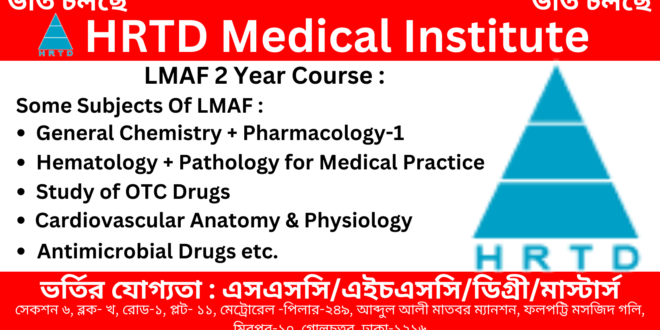
LMAF course 2 Years. Mobile number- 01987073965, 01797522136. LMAF 2 Years courses are long course for Local Medical Assistant and Family Welfare.
- Total Subjects : 18
- Total Exam Marks : 1800
- Total Semester : 4
1’st Semester for Local Medical Assistant and Family Welfare 2 Year
- Human Anatomy & Physiology…………………………..Marks-100
- General Chemistry + Pharmacology-1……………….Marks-100
- First Aid-1 + Practice of Medicine…………………..….Marks-100
- Hematology + Pathology for Medical Practice…..Marks-100
- Study of OTC Drugs…………………………………….………Marks-100
2’nd Semester for Local Medical Assistant and Family Welfare 2 Year
- Cardiovascular Anatomy & Physiology………………Marks-100
- Medical Biochemistry……………..……………………………Marks-100
- Surgery-1……………………………………………………………..Marks-100
- Antimicrobial Drugs….…………………………………………Marks-100
- Medical Diagnosis-1 & 2……..……………………………..Marks-100
3’rd Semester for Local Medical Assistant and Family Welfare 2 Year
- Orthopedic Anatomy & Physiology……………………Marks-100
- Microbiology……………………………………………………….Marks-100
- Pharmacology-2…………………………………………..……..Marks-100
- Pathology-1 & 2……………………………………………..…..Marks-100
4’th Semester for Local Medical Assistant and Family Welfare 2 Year
- Anatomy & Physiology-2……………………………………Marks-100
- Histology & Cytology……………………………………..…..Marks-100
- Practice of Medicine-2…………………………………………Marks-100
- Respiratory Disease & Treatment…………………..……Marks-100
Weekly classes of Local Medical Assistant and Family Welfare
1.Weekly class 3 hours for LMAF 2 Years course
2.For job holder 3 hours in a day. Friday, Saturday and Monday .Our class shift Friday morning shift 9am to 12pm and evening shift 3pm to 6 pm, Saturday morning shift 10am to 1pm and evening shift 3pm to 6pm, Monday morning shift 9am to 12pm and evening shift 3pm to 6pm.
3.For regular students 1 hour on Friday, 1 hour Saturday, ! hour Monday.
- Classes :
- One Class in a week.
Total Classes ( 3 × 96 )
Local Medical Assistant and Family Welfare Course In Mirpur
- Cost Summary :
- Total Course Fee : 92,500 /-
- Admission Fee :16,500 /-
- Monthly Fee : (24 × 2500)
- Exam Fee : 2 x 8000 /-
Practical Class for Local Medical Assistant and Family Welfare 2 Year
Cardiac Auscultation, Pulmonary Auscultation, Abdominal Auscultation, Heart Beat, Heart Rate, Heart Sound, Pulse, Radial Pulse, Carotid Pulse, Blood Pressure, Normal BP, Hypertension, Hypotension, Respiratory Rate, Inhaler, Rota Haler, Nebulizer, Blood Oxygen, Cyanosis, Blood Collection, Blood Glucose (Diabetes), Blood Grouping, Body Temperature, Dehydration Test, Edema Test, IM Injection, IV Injection, Saline Infusion, Cleaning, Dressing, Bandaging etc.
Anatomy & Physiology of Local Medical Assistant and Family Welfare 2 Year
Anatomy and Physiology is an important subject for medical science. The study of Body Structure and its functions is Anatomy and Physiology. Here we discuss the systems of the Human Body and its Organs, Tissues, and Cells. The systems of the Human Body are the Nervous System, Digestive System, Respiratory System, Circulatory System or Cardiovascular System, Skeletal System, Muscular System, Endocrine System, Immune System, Lymphatic System, Integumentary System or Covering System, and Urinary System.

Anatomy and physiology are the dual biological sciences that study the human body’s structure and function. They are inherently linked because a body part’s form (anatomy) often dictates what it does (physiology).
1. Anatomy (Structure)
Anatomy is the study of internal and external body structures and their physical relationships. It is divided into several branches:
- Gross (Macroscopic) Anatomy: The study of structures visible to the naked eye, such as bones or internal organs, often through dissection.
- Microscopic Anatomy: The study of tiny structures requiring magnification:
- Cytology: The study of individual cells.
- Histology: The study of tissues.
- Regional Anatomy: The study of all structures in a specific area, such as the head or thorax.
- Systemic Anatomy: The study of specific organ systems, such as the skeletal or nervous system.
2. Physiology (Function)
Physiology is the study of how body parts function together to sustain life. It explores the mechanical, physical, and biochemical processes of the body. Common areas include:
- Cellular Physiology: How individual cells work and maintain internal balance.
- Systemic Physiology: The function of specific organ systems (e.g., cardiovascular or respiratory physiology).
- Pathophysiology: The study of how disease or injury disrupts normal physiological processes.
3. Levels of Organization
The human body is organized into increasingly complex levels:
- Chemical Level: Atoms (e.g., hydrogen, carbon) and molecules (e.g., DNA, water).
- Cellular Level: The basic functional unit of life.
- Tissue Level: Groups of similar cells working together (e.g., muscle, nervous tissue).
- Organ Level: Different tissues working for a common purpose (e.g., stomach, heart).
- Organ System Level: A group of organs that cooperate to perform major functions (e.g., digestive system).
- Organism Level: The whole human being.
4. Core Concepts
- Homeostasis: The body’s state of steady internal equilibrium (e.g., maintaining body temperature or blood sugar). Most diseases result from a failure of homeostasis.
- Anatomical Terminology: Standardized language used to describe locations (e.g., superior, inferior) and body planes (e.g., sagittal, frontal) to avoid confusion
Pharmacology for Local Medical Assistant and Family Welfare 2 Year
Pharmacology is an important subject in Local Medical Assistant and Family Welfare. The study of drugs knowledge & Medicine is called Pharmacology. Common groups of Drugs are Antiulcer drug, Antidiabetic drugs, Antihistamine drugs, Anti Inflammatory drugs, Antipyretic drugs, Anthelmintic drug, Antiprotozoa drugs, Anti bacteria drugs, NSAID drugs, Steroid drugs etc.
Pharmacology is the scientific study of drugs and chemicals, exploring how they interact with living organisms, their origins, therapeutic uses, mechanisms (pharmacodynamics), and how the body processes them (pharmacokinetics), encompassing drug discovery, development, and the understanding of adverse effects to improve health and treat diseases. It bridges basic sciences like biology and chemistry with medicine, focusing on how substances affect biological systems and the design of new medicines.
Key Areas of Pharmacology
- Pharmacokinetics (PK): What the body does to the drug (Absorption, Distribution, Metabolism, Excretion – ADME).
- Pharmacodynamics (PD): What the drug does to the body, including its effects and mechanisms of action.
- Toxicology: Study of harmful effects of drugs and chemicals.
- Therapeutics: Application of drugs to prevent, treat, or cure diseases.
- Drug Discovery & Development: Identifying targets, designing, and creating new drugs.
What Pharmacologists Do
- Research how drugs work at molecular and cellular levels.
- Develop new treatments for conditions like cancer, infections, and heart disease.
- Study how genes affect drug response (pharmacogenomics).
- Ensure safe and effective drug use through clinical trials and research.
Importance
Pharmacology underpins modern medicine, guiding dosing instructions on medicine bottles and enabling the creation of treatments for countless illnesses, bridging fundamental science with clinical practice.
Study of OTC Drugs for Local Medical Assistant and Family Welfare 2 Year
OTC is the short form of over-the-counter. That is OTC Drugs are over-the-counter drugs. The study of OTC Drugs is important for RMP Courses. These Drugs can be sold or purchased without any prescription from Registered MBBS Doctors. These Drugs are Emergency and Safe for the patients. The study of OTC Drugs improves the quality of practice. Some OTC Drugs are Paracetamol, Albendazole, Ascorbic Acid, Calcium, Multivitamins, Vitamin B Complex, Omeprazole, Oral Rehydration Salt, Salbutamol, Mebendazole, Neomycin, Gentamycin, Bacitracin, etc
First Aid 1 & 2 for Local Medical Assistant and Family Welfare 2 Year
First Aid 1 & 2 are sequential training levels, with Level 1 covering foundational, life-saving skills (CPR, bleeding, choking, basic injuries) for everyday emergencies, suitable for low-risk settings, while Level 2 (Intermediate) builds on this with more advanced techniques like splinting, deeper wound care, and managing more complex scenarios (fractures, severe bleeding, shock), preparing for higher-risk workplaces or community roles.
First Aid Level 1: Basic Life Support
- Focus: Essential, immediate, life-saving interventions.
- Key Topics:
- Principles of first aid & scene assessment.
- Cardio-Pulmonary Resuscitation (CPR) & Automated External Defibrillator (AED) use.
- Managing choking & airway obstruction.
- Controlling bleeding & dressing wounds.
- Treating burns, shock, & fainting.
- Best For: General public, office staff, low-risk environments.
First Aid Level 2: Intermediate Life Support
- Focus: Advanced care beyond Level 1, often for higher-risk workplaces.
- Key Topics (in addition to Level 1):
- More complex bandaging & splinting techniques.
- In-depth management of fractures, dislocations, & sprains.
- Handling specific illnesses (e.g., strokes, heart attacks).
- Managing bites, stings, & environmental emergencies.
- Best For: Workplaces with higher risks, designated first aiders, community settings.
Key Difference
Level 1 teaches you what to do in basic emergencies; Level 2 teaches you more advanced ways to manage injuries and sudden illnesses, bridging the gap until professional medical help arrives.
Antimicrobial Drugs for Local Medical Assistant and Family Welfare 2 Year
The subject of Antimicrobial Drugs covers medicines like antibiotics, antivirals, antifungals, and antiparasitics that kill or stop the growth of microbes (bacteria, viruses, fungi, parasites) to treat and prevent infections, focusing on how they work (mechanisms), their selective toxicity (harming microbes but not hosts), classification (spectrum, function), administration, and the critical issue of antimicrobial resistance (AMR). It’s a key area in medicine, pharmacology, and microbiology, exploring development, testing, and challenges like “superbugs”.
Key Areas within the Subject:
- Types of Agents:
- Antibiotics: Target bacteria (e.g., Penicillin, Sulfonamides).
- Antivirals: Target viruses (e.g., Acyclovir).
- Antifungals: Target fungi (e.g., Ketoconazole).
- Antiparasitics: Target parasites (e.g., Mefloquine, Niclosamide).
- Mechanisms of Action: How drugs inhibit or kill microbes (e.g., cell wall synthesis, protein synthesis, folic acid production).
- Selective Toxicity: Designing drugs to harm microbes more than host cells.
- Classification:
- By Spectrum: Narrow-spectrum (specific microbes) vs. Broad-spectrum (wide range).
- By Effect: Bactericidal (kill) vs. Bacteriostatic (inhibit growth).
- Pharmacology & Administration: Dosage, routes (oral, IV), pharmacokinetics (half-life, organ function).
- Resistance: Microorganisms developing ways to survive drugs, leading to “superbugs”.
- Discovery & Development: History (Fleming’s penicillin) and modern strategies.
Why it Matters:
- Essential for treating infections in humans, animals, and plants.
- Combating the growing threat of antimicrobial resistance (AMR).
- Understanding specific drug properties (e.g., Penicillins for syphilis/diphtheria
Teachers for LMAF Course
Teachers for LMAF Course
Dr. Sakulur Rahman, MBBS, CCD, PGT
Dr. Suhana, MBBS, PGT
Dr. Lamia, MBBS, PGT
Dr. Shamima, MBBS, PGT
Dr. Disha, MBBS, FCPS
Dr. Tisha, MBBS, PGT Medicine
Dr. Mahinul Islam, MBBS,
Dr. Turzo, MBBS, FCPS
Dr. Juthi, BDS, PGT
Dr. Sanjana, BDS, MPH
Dr. Keya, BDS, PGT
Others Village Doctors Courses
Village Doctors courses of HRTD Medical Institute are RMP course-6Month,DMA course 1Year, DMA course 2Years,DMS 1Year, DMS 2Years, DMDS course 4Yeras,LMA course 6Month, DMSc course 4Years. All these courses are available at HRTD Medical Institute.