 MATCDHAKA – Medical Assistant Training Centre in Dhaka Pharmacy, Veterinary, Dental, Nursing, Pathology, Physiotherapy and Homeopathy Training Institute in Dhaka



Paramedical 1 Year
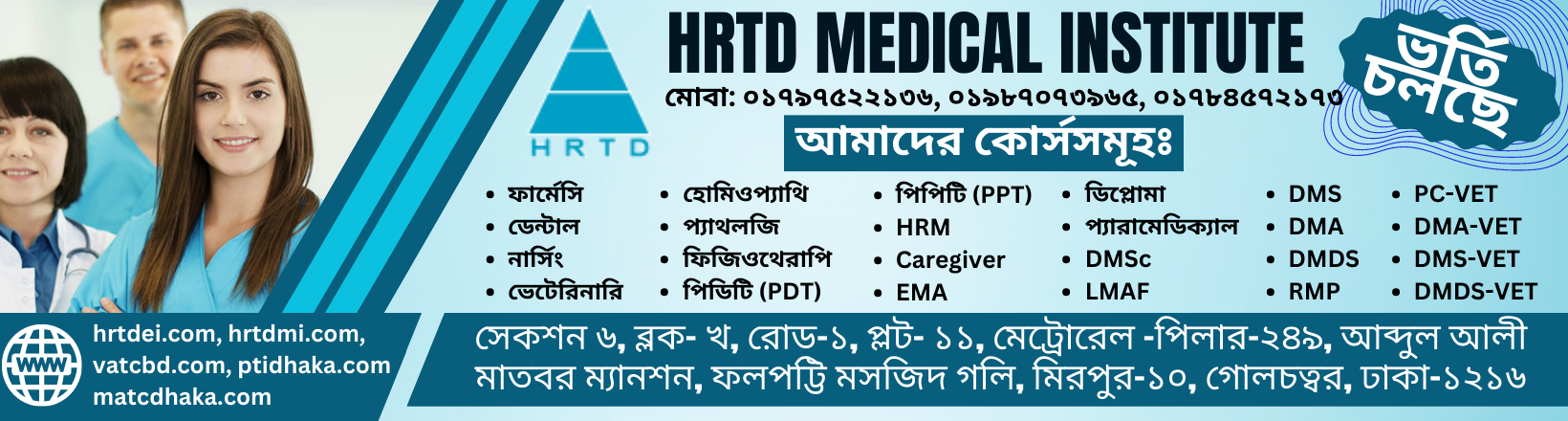
Paramedical 1 Year is a short paramedical course. This course is very helpful for pharmacy business and primary treatment. HRTD Medical Institute provides this course. HRTD Medical Institute is an organization of HRTD Limited which is Registered by the Govt of the People Republic of Bangladesh.
Location of Paramedical 1 Year Course
HRTD Medical Institute, Abdul Ali Madbor Mansion, Folpotty Mosjid Goli (Bitul Mamur Jame Mosjid Goli), Plot No. 11, Metro Rail Piller No. 249, Mirpur 10 Golchattar, Dhaka.
Subjects for Paramedical 1 Year Course
- Human Anatomy and Physiology
- Pharmacology
- First Aid
- Study of OTC Drugs
- Practice of Medicine-1
- Hematology and Pathology
- Microbiology and Antimicrobial Drugs
- Study of Gastrology
- Study of Cardiology
- Study of Orthopedics
Teachers for Paramedical 1 Year Course
- Dr. Sakulur Rahman, MBBS, PGT, CCD
- Dr. Shamima, MBBS
- Dr. Disha, MBBS
- Dr. Tisha, MBBS
- Dr. Sanjana, BDS
- Dr. Juthi, BDS
- Dr. Keya, BDS
- Dr. Mahinul Islam, MBBS
- Dr. Antora, MBBS
- Dr. Turzo, MBBS
Practical Class for Paramedical 1 Year Course
Heart Beat,Heart Rate, Pulse, Pulse Rate, Heart Sound, Blood Pressure, Systolic Blood Pressure, Diastolic Blood Pressure, Pulse Pressure, Mean Blood Pressure, Hypertension, Hypotension, Tachycardia, Bradycardia, Injection, IM Injection, IV Injection, SC Injection, Saline Pushing, Cleaning, Dressing, Bandaging, Stiching, Inhalar, Rotahalar, Nebulizer, Diabetes Test (Blood Glucose Test), Pulse Oxymeter, Saturated Oxygen, Oxygen Inhalation, and etc.
Human Anatomy and Physiology

View all
Human anatomy is the scientific study of the body’s structures, divided into gross anatomy (visible parts) and microscopic anatomy (cells, tissues via microscope). It’s studied through methods like regional (body parts), systemic (body systems like skeletal, nervous, digestive), and clinical approaches, using tools from dissection to advanced medical imaging (MRI, CT) to understand the musculoskeletal, circulatory, respiratory, nervous, and other vital systems, crucial for medicine.
Main Branches
- Gross Anatomy (Macroscopic): Study of structures visible to the naked eye, including superficial (surface) anatomy.
- Microscopic Anatomy: Uses microscopes; includes:
- Histology: Study of tissues.
- Cytology: Study of cells.
Key Study Methods
- Regional Anatomy: Focuses on specific body areas (e.g., head, limbs).
- Systemic Anatomy: Organizes the body by functional systems (e.g., cardiovascular, nervous).
- Clinical/Applied Anatomy: Practical application for medicine.
- Medical Imaging: CT, MRI, X-ray for non-invasive views.
Major Body Systems
- Skeletal & Muscular: Bones, muscles for movement, posture, heat.
- Nervous: Brain, spinal cord, nerves for control.
- Circulatory (Cardiovascular): Heart, blood vessels for transport.
- Respiratory: Lungs, airways for breathing.
- Digestive: Mouth, stomach, intestines for nutrient processing.
- Integumentary: Skin, hair, nails for protection, sensation.
- Endocrine: Glands producing hormones.
- Urinary (Excretory): Kidneys, bladder for waste removal.
- Reproductive: Organs for reproduction.
- Immune: Defense against pathogens.
Human physiology is the scientific study of how the normal human body and its systems (like nervous, cardiovascular, digestive) function, focusing on the chemical and physical processes that keep us alive, maintain stability (homeostasis), and adapt to challenges, from molecular levels up to organs and systems working together. It’s the foundation of medicine, explaining the “how” and “why” behind bodily functions and what goes wrong in disease.
Core Concepts
- Function & Mechanism: Explores the mechanical, physical, and biochemical operations of cells, tissues, organs, and systems.
- Homeostasis: A central theme; the body’s ability to maintain a stable internal environment (e.g., temperature, blood sugar, pH) despite external changes.
- Integration: Studies how different organ systems (nervous, endocrine, respiratory, etc.) work together to achieve overall body function.
- Levels of Organization: Examines functions from atoms and molecules to cells, tissues, organs, and organ systems.
Key Organ Systems Studied
- Nervous System: Relays signals, controls responses (brain, nerves).
- Endocrine System: Regulates via hormones (glands).
- Cardiovascular System: Circulates blood (heart, vessels).
- Respiratory System: Gas exchange (lungs).
- Digestive System: Nutrient processing (stomach, intestines).
- Urinary/Excretory System: Waste removal (kidneys).
- Musculoskeletal, Reproductive, etc. .
Pharmacology
Pharmacology is the scientific study of drugs and chemicals, exploring how they interact with living systems to prevent, diagnose, or treat diseases, covering their origins, effects (pharmacodynamics), how the body handles them (pharmacokinetics), and their toxicology. It bridges basic sciences like biology and chemistry, involving drug discovery, development, and understanding molecular mechanisms to improve health, distinct from pharmacy, which focuses on drug use in clinical settings.
What Pharmacology Studies
- Drug Action: How drugs bind to molecular targets (receptors, enzymes) and cause effects.
- Pharmacokinetics (ADME): What the body does to the drug (Absorption, Distribution, Metabolism, Excretion).
- Pharmacodynamics (PD): What the drug does to the body (physiological/behavioral effects).
- Toxicology: Adverse effects and mechanisms of toxicity.
- Drug Development: From identifying targets to designing and testing new medicines.
Key Areas & Sub-disciplines
- Clinical Pharmacology: Study of drugs in humans.
- Molecular Pharmacology: Focuses on molecular mechanisms of drug action.
- Neuropharmacology: Drugs affecting the nervous system.
- Cardiovascular Pharmacology: Drugs affecting the heart and blood vessels.