 MATCDHAKA – Medical Assistant Training Centre in Dhaka Pharmacy, Veterinary, Dental, Nursing, Pathology, Physiotherapy and Homeopathy Training Institute in Dhaka



Best DMDS Course In Dhaka Details
Best DMDS Course In Dhaka in Bangladesh. This Course is available in HRTD Medical Institute. HRTD Medical Institute is reputed and popular for Paramedical Courses, Pharmacy Courses, Diploma Medical Assistant Courses, etc. HRTD Medical Institute is an organization of HRTD Limited which is Registered by the Govt of the People Republic of Bangladesh.
Location of Best DMDS Course In Dhaka
Best DMDS Course In Dhaka HRTD Medical Institute, Abdul Ali Madbor Mansion, Folpotty Mosjid Goli (Bitul Mamur Jame Mosjid Goli), Plot No. 11, Metro Rail Piller No. 249, Mirpur 10 Golchattar, Dhaka.
Class System for Best DMDS Course In Dhaka
Class System for Best DMDS Course In Dhaka : Weekly Class 3 hours. For Job holders 3 hours in a day. The option days are Friday Morning Shift from 9:00 AM to 12:00 PM, Friday Evening Shift from 3:00 PM to 6:00 PM, Monday Morning Shift from 9:00 AM to 12:00 PM, Monday Evening Shift from 3:00 PM to 6:00 PM. Saturday Morning Shift from 10am to 1 Pm, Evening Shift from 3 pm to 6 pm.
For Regular Students Saturday 1 hour, Monday 1 hour, and Friday 1 hour. Morning Shift From 9:00 AM to 12:00 PM, and Evening Shift From 3:00 PM to 6:00 PM.
Document for Best DMDS Course In Dhaka
Best DMDS Course In Dhaka. Mobile No: 01987-073965, 01797-522136. HRTD Medical Institute.
Photocopy of Certificate, Photocopy of NID, Passport Size Photo 4 Pcs. Without NID, a Birth Certificate is allowed for an emergency case.
Hostel Facilities in HRTD Medical Institute for Best DMDS Course In Dhaka
Hostel & Meal Facilities Best DMDS Course In Dhaka
The Institute has hostel facilities for the students. Students can take a bed in the hostel.
Hostel Fee Tk 3000/- Per Month
Meal Charges Tk 3000/- Per Month. ( Approximately )
হোস্টাল ও খাবার সুবিধা
ইনস্টিটিউটে শিক্ষার্থীদের জন্য হোস্টেল সুবিধা রয়েছে। ছাত্ররা হোস্টেলে বিছানা নিতে পারে।
হোস্টেল ফি 3000/- টাকা প্রতি মাসে,
খাবারের চার্জ 3000/- টাকা প্রতি মাসে।(প্রায়)
Subjects for Best DMDS Course In Dhaka
- Human Anatomy and Physiology
- Pharmacology
- First Aid 1 & 2
- Study of OTC Drugs
- Practice of Medicine-1
- Hematology and Pathology
- Microbiology and Antimicrobial Drugs
- Study of Gastrology
- Study of Cardiology
- Study of Orthopedics
- Surgery
- Neuro Anatomy
- General Pathology-1
- General Chemistry & Biochemistry
- Community Medicine
- ENT Drugs & Pharmacology
- Human Anatomy & Physiology 2
- Cardiovascular Anatomy
- Orthopedic Anatomy
- Medical Diagnosis
Course fee for Best DMDS Course In Dhaka
Best DMDS Course In Dhaka Mobile Number. 01987073965. 01941123488, 01797522136. Best DMDS Course In Dhaka HRTD Medical Institute
Best DMDS Course In Dhaka
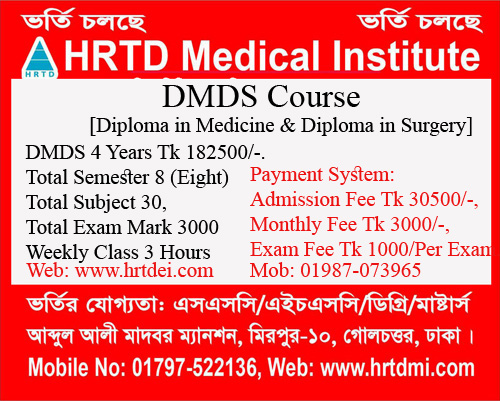
- Total Cost = 182500 tk
- Admission Fee = 30500 tk
- Monthly Fee = ( 3000 x 48 ) 144000 tk
- Exam Fee = 8000 tk ( 8 semester )
- Total Subject = 30
- Total Marks =3000
Teachers for Best DMDS Course In Dhaka
- Dr. Md. Sakulur Rahman, MBBS, CCD (BIRDEM), Course Director
- Dr. Sanjana Binte Ahmed, BDS, MPH, Assistant Course Director
- Dr. Tisha, MBBS, PGT Gyne, Assistant Course Director
- Dr. Suhana, MBBS, PGT Medicine
- Dr. Danial Hoque, MBBS, C-Card
- Dr. Tisha, MBBS
- Dr. Afrin Jahan, MBBS, PGT Medicine
- Dr. Ananna, MBBS
- Dr. Lamia Afroze, MBBS
- Dr. Amena Afroze Anu, MBBS, PGT Gyne, Assistant Course Director
- Dr. Farhana Antara, MBBS,
- Dr. Nazmun Nahar Juthi, BDS, PGT
- Dr. Farhana Sharna, MBBS
- Dr. Bushra, MBBS
- Dr. Turzo, MBBS
- Dr. Kamrunnahar Keya, BDS, PGT (Dhaka Dental College)
- Dr. Shamima, MBBS, PGT Gyne
- Dr. Alamin, MBBS
- Dr. Benzir Belal, MBBS
- Dr. Disha, MBBS
- Dr. Mahinul Islam, MBBS,
- Dr. Tisha, MBBS, PGT Medicine
- Dr. Anika, MBBS, PGT
- Dr. Jannatul Ferdous, MBBS, PGT Gyne
- Dr. Jannatul Aman, MBBS, PGT
- Dr. Rayhan, BPT
- Dr. Abu Hurayra, BPT
- Dr. Sharmin Ankhi, MBBS, PGT Medicine
- Md. Monir Hossain, B Pharm, M Pharm
- Md. Monirul Islam, B Pharm, M Pharm
- Md. Feroj Ahmed, BSc Pathology, PDT Medicine
Practical Class for Best DMDS Course In Dhaka
- Heart Beat, Heart Rate
- Heart Sound,Pulse
- Blood Pressure, Hypertension, Hypotension
- First Aid Box
- Auscultation
- Inhaler, Rotahaler
- Nebulizer
- Glucometer Blood Glucose
- Injection I/V
- Injection I/M
- Cleaning,Dressing,Bandaging
- Saline
- CPR
- Stitch
- Body Temperature
- Nasal Tube Gel ,Hand Wash
- Blood Grouping
- Cyanosis, Dehydration Test, Edema Test
Practical Works. Mobile Phone 01797522136, 01987073965. There are many practical works in the Paramedical 4 Years Course. The Practical works are Heart Beat, Heart Rate, Pulse, Pulse Rate, Weak Pulse, Strong Pulse, Atrial Beat, Ventricular Beat, Tachycardia, Bradycardia, Arrhythmia, Heart Sound, Normal Heart Sound, Abnormal Heart Sound, Cardiac Mur Mur, Blood Pressure, Systolic Blood Pressure, Diastolic Blood Pressure, Pulse Pressure, Mean Blood Pressure.
Hypertension, Hypotension, Hypertension Emergency, Management of Hypertension, Management of Hypotension, Management of Hypertension Emergency, IM Injection, IV Injection, SC Injection, ID Injection, Saline Pushing, Application of Eye Drops, Application of Pediatric Medicine, Emergency Respiratory Drugs, Use of Inhaler, Use of Ratahaler, Use of Nebulizer.
BMI, Normal Body Weight, Under Weight, Over Weight, Obesity, Cleaning, Dressing, Bandaging, Use of Mouth Anti Septic Mouth Wash, Use of Suppository, Use of Eye Drops, Use of Ear Drops, Use of Skin Ointment and Cream, Canulla Setting, Post Surgical Cleaning, Post Surgical Dressing, Post Surgical Bandaging, Post Surgical Pain Management. Roller Bandage, Triangular Bandage.
Making Suspension from PFS, Making Solution from ORS, Auscultation, Auscultation of Thorax, Respiratory Auscultation, Abdominal Auscultation, Percussion, Appendicitis Pulpation, Prescription Understanding, Report Understanding, X-Ray Report Understanding, Blood Test Report Understanding, Urine Test Report Understanding, ECG Report Understanding, Echo Report Understanding, ETT Report Understanding.
Subject Details for Best DMDS Course In Dhaka
Human Anatomy & Physiology for Best DMDS Course In Dhaka
The Study of the body Structure and its function is Anatomy & Physiology. Here we discuss the systems of the human body and its organ, Tissues, and cells. The systems of the human body are the digestive system, Respiratory system, Cardiovascular system, Skeletal system, Muscular system, nervous system, Endocrine system, Immune System, Integumentary System and Urinary System.
দেহ গঠন এবং এর কার্যকারিতা অধ্যয়নের বিষয় হল অ্যানাটমি এবং ফিজিওলজি। এখানে আমরা মানবদেহের সিস্টেম এবং এর অঙ্গ, টিস্যু এবং কোষ নিয়ে আলোচনা করব। মানবদেহের সিস্টেমগুলি হল পাচনতন্ত্র, শ্বাসযন্ত্র, হৃদযন্ত্র, কঙ্কালতন্ত্র, পেশীতন্ত্র, স্নায়ুতন্ত্র, অন্তঃস্রাবী ব্যবস্থা, রোগ প্রতিরোধ ব্যবস্থা, ইন্টিগুমেন্টারি সিস্টেম এবং মূত্রতন্ত্র।

Human anatomy is the scientific study of the body’s structural composition (cells, tissues, organs, systems), while physiology focuses on the functions and internal mechanisms of these structures. Together, they explore how the body maintains life, with the core principle that structure determines function (anatomy fits physiology).
মানব শারীরস্থান হল শরীরের কাঠামোগত গঠনের (কোষ, টিস্যু, অঙ্গ, সিস্টেম) বৈজ্ঞানিক অধ্যয়ন, যখন শারীরবিদ্যা এই কাঠামোর কার্যকারিতা এবং অভ্যন্তরীণ প্রক্রিয়াগুলির উপর দৃষ্টি নিবদ্ধ করে। একসাথে, তারা অন্বেষণ করে যে শরীর কীভাবে জীবন বজায় রাখে, মূল নীতিটি হল গঠন কার্যকারিতা নির্ধারণ করে (শারীরস্থান শারীরবিদ্যার সাথে খাপ খায়)।
Definition Best DMDS Course In Dhaka
Anatomy (English):
Anatomy is the study of the structure of the human body and the relationship between body parts.
অ্যানাটমি (বাংলা):
অ্যানাটমি হলো মানবদেহের গঠন, অঙ্গ-প্রত্যঙ্গ এবং তাদের পারস্পরিক সম্পর্কের অধ্যয়ন।
Physiology (English):
Physiology is the study of the functions of the human body and how body parts work.
ফিজিওলজি (বাংলা):
ফিজিওলজি হলো মানবদেহের বিভিন্ন অঙ্গ কীভাবে কাজ করে তার অধ্যয়ন।
Levels of Organization (শরীরের গঠনের স্তর)
- Cell (কোষ) – দেহের সবচেয়ে ছোট জীবিত একক
- Tissue (টিস্যু) – একই ধরনের কোষের সমষ্টি
- Organ (অঙ্গ) – বিভিন্ন টিস্যু দিয়ে গঠিত (যেমন: হৃদপিণ্ড)
- System (সিস্টেম) – একাধিক অঙ্গের সমন্বয়
- Organism (সম্পূর্ণ মানবদেহ)
Major Systems of Human Body for Best DMDS Course In Dhaka
| System | Main Function |
|---|---|
| Skeletal System | দেহকে আকৃতি ও সাপোর্ট দেয় |
| Muscular System | চলাচল ও শক্তি উৎপাদন |
| Nervous System | দেহের নিয়ন্ত্রণ ও সমন্বয় |
| Cardiovascular System | রক্ত পরিবহন |
| Respiratory System | শ্বাস-প্রশ্বাস |
| Digestive System | খাদ্য হজম |
| Urinary System | বর্জ্য নির্গমন |
| Endocrine System | হরমোন নিঃসরণ |
| Reproductive System | প্রজনন |
| Integumentary System | ত্বক ও সুরক্ষা |
কয়েকটি সিস্টেম সম্পর্কে আলোচনা করা হলো:
1. Skeletal System for Best DMDS Course In Dhaka
The human skeletal system is a complex framework of 206 bones (in adults) that provides structural support, facilitates movement, and protects vital organs. It is more than just bones; it includes joints, cartilage, ligaments, and tendons.
মানুষের কঙ্কালতন্ত্র হল ২০৬টি হাড়ের (প্রাপ্তবয়স্কদের) একটি জটিল কাঠামো যা কাঠামোগত সহায়তা প্রদান করে, চলাচল সহজতর করে এবং গুরুত্বপূর্ণ অঙ্গগুলিকে রক্ষা করে। এটি কেবল হাড়ের চেয়েও বেশি কিছু; এর মধ্যে রয়েছে জয়েন্ট, তরুণাস্থি, লিগামেন্ট এবং টেন্ডন।
Function Best DMDS Course In Dhaka
- Gives shape and support to the body
- Protects vital organs (brain, heart, lungs)
- Helps in body movement
- Produces blood cells in bone marrow
Main Parts Best DMDS Course In Dhaka
- Bones (206 bones)
- Joints
- Cartilage
2. Muscular System for Best DMDS Course In Dhaka
The muscular system as your body’s engine room. It’s a vast network of over 600 muscles that do everything from the obvious (lifting weights) to the silent (keeping your heart beating).
পেশীতন্ত্র আপনার শরীরের ইঞ্জিন রুম হিসেবে কাজ করে। এটি ৬০০ টিরও বেশি পেশীর একটি বিশাল নেটওয়ার্ক যা স্পষ্ট (ওজন তোলা) থেকে শুরু করে নীরব (আপনার হৃদস্পন্দন বজায় রাখা) পর্যন্ত সবকিছু করে।
Function Best DMDS Course In Dhaka
- Enables movement of the body
- Maintains posture
- Produces heat
Types of Muscles Best DMDS Course In Dhaka
- Skeletal muscle – voluntary
- Smooth muscle – involuntary
- Cardiac muscle – found in the heart
3. Nervous System for Best DMDS Course In Dhaka
The nervous system is your body’s command center, a complex network of cells and nerves that carries messages between your brain and the rest of your body. It controls everything from voluntary movements like walking to involuntary processes like your heartbeat and digestion.
স্নায়ুতন্ত্র হল আপনার শরীরের কমান্ড সেন্টার, কোষ এবং স্নায়ুর একটি জটিল নেটওয়ার্ক যা আপনার মস্তিষ্ক এবং আপনার শরীরের বাকি অংশের মধ্যে বার্তা বহন করে। এটি হাঁটার মতো স্বেচ্ছাসেবী নড়াচড়া থেকে শুরু করে আপনার হৃদস্পন্দন এবং হজমের মতো অনিচ্ছাকৃত প্রক্রিয়া পর্যন্ত সবকিছু নিয়ন্ত্রণ করে।
Function Best DMDS Course In Dhaka
- Controls and coordinates body activities
- Receives and responds to stimuli
- Responsible for thinking, memory, and emotions
Main Parts:
- Brain
- Spinal cord
- Nerves
4. Cardiovascular System for Best DMDS Course In Dhaka
The cardiovascular system, also known as the circulatory system, is an intricate network consisting of the heart, blood vessels, and blood. Its primary role is to act as a transportation hub, delivering oxygen, nutrients, and hormones to cells while removing waste products like carbon dioxide to maintain homeostasis.
হৃদযন্ত্র, যা সংবহনতন্ত্র নামেও পরিচিত, হৃৎপিণ্ড, রক্তনালী এবং রক্তের সমন্বয়ে গঠিত একটি জটিল নেটওয়ার্ক। এর প্রাথমিক ভূমিকা হল পরিবহন কেন্দ্র হিসেবে কাজ করা, কোষে অক্সিজেন, পুষ্টি এবং হরমোন সরবরাহ করা এবং একই সাথে কার্বন ডাই অক্সাইডের মতো বর্জ্য পদার্থ অপসারণ করে হোমিওস্ট্যাসিস বজায় রাখা।
Function:
- Circulates blood throughout the body
- Transports oxygen, nutrients, and hormones
- Removes waste products
Main Parts:
- Heart
- Blood
- Blood vessels (arteries, veins, capillaries)
5. Respiratory System for Best DMDS Course In Dhaka
The respiratory system is a biological network of organs and tissues that allows you to breathe, facilitating the vital exchange of oxygen and carbon dioxide.
শ্বসনতন্ত্র হল অঙ্গ এবং টিস্যুর একটি জৈবিক নেটওয়ার্ক যা আপনাকে শ্বাস নিতে সাহায্য করে, অক্সিজেন এবং কার্বন ডাই অক্সাইডের গুরুত্বপূর্ণ বিনিময়কে সহজতর করে।
Pharmacology for Best DMDS Course In Dhaka
The study of Drugs and Medicine is called Pharmacology. Drugs are chemicals that can react with cells, tissues, and body organs. Here we discuss group-wise drugs and their medicines. Common Groups of Drugs are Pain Killer Drugs, Anti Ulcer Drugs, Anti Vomiting Drugs, Anti Viral Drugs, Laxative Drugs, Motility Drugs and Antimotility Drugs, Bronchodilator Drugs, Antibiotic Drugs, Anti Fungal Drugs, Anti Thrombotic Drugs, Anti Protozoal Drugs, Anthelmintic Drugs, Anti Hypertensive Drugs, Beta Blocker Drugs, Calcium Channel Blocker Drugs, ACE Inhibitor Drugs, Hemostatic Drugs, Analgesic Drugs, Antipyretic Drugs, Steroid Drugs, NSAID Drugs, CNS Drugs, Neuropathic Pain Keller Drugs, Spasmodic Drugs, etc.
ঔষধ ও চিকিৎসাবিজ্ঞানের অধ্যয়নকে ফার্মাকোলজি বলা হয়। ঔষধ হলো এমন রাসায়নিক পদার্থ যা কোষ, কলা এবং দেহের অঙ্গপ্রত্যঙ্গের সাথে প্রতিক্রিয়া করতে পারে। এখানে আমরা শ্রেণী অনুযায়ী ঔষধ এবং তাদের ঔষধ নিয়ে আলোচনা করব। ঔষধের সাধারণ শ্রেণীগুলো হলো: ব্যথানাশক ঔষধ, আলসাররোধী ঔষধ, বমিরোধী ঔষধ, অ্যান্টিভাইরাল ঔষধ, জোলাপ ঔষধ, গতিশীলতা বৃদ্ধিকারী ও গতিরোধকারী ঔষধ, ব্রঙ্কোডাইলেটর ঔষধ, অ্যান্টিবায়োটিক ঔষধ, ছত্রাকরোধী ঔষধ, রক্ত জমাট বাঁধারোধী ঔষধ, প্রোটোজোয়ারোধী ঔষধ, কৃমিনাশক ঔষধ, উচ্চ রক্তচাপরোধী ঔষধ, বিটা ব্লকার ঔষধ, ক্যালসিয়াম চ্যানেল ব্লকার ঔষধ, এসিই ইনহিবিটর ঔষধ, রক্তক্ষরণ রোধকারী ঔষধ, ব্যথানাশক ঔষধ, জ্বরনাশক ঔষধ, স্টেরয়েড ঔষধ, এনএসএআইডি ঔষধ, সিএনএস ঔষধ, নিউরোপ্যাথিক ব্যথানাশক ঔষধ, খিঁচুনি জনিত ঔষধ, ইত্যাদি।
Core Branches of Pharmacology for Best DMDS Course In Dhaka
The field is traditionally divided into two main areas that describe the relationship between a drug and the body:
- Pharmacodynamics (PD): Often described as “what the drug does to the body”. This involves studying the biochemical and physiological effects of drugs and their mechanisms of action, such as how they bind to specific receptors.
- Pharmacokinetics (PK): Often described as “what the body does to the drug”. It focuses on the ADME process: Absorption, Distribution, Metabolism, and Excretion.
Key Concepts
- Selectivity: The ability of a drug to affect a specific target without causing unintended side effects in other tissues.
- Therapeutic Window: The range of drug concentrations in the blood that provides the desired effect without reaching toxic levels.
- Clinical Pharmacology: The application of pharmacological principles to the treatment of patients, focusing on safe and economic use of medicines
First Aid for Best DMDS Course In Dhaka
Best DMDS Course In Dhaka First Aid is an important subject for all courses. It is very important for the RMP Course. Here we discuss Shock, Classifications of Shock, Causes of Shock, Stages of Shock, Clinical Features of Shock, Hypovolemic Shock, Cardiogenic Shock, Neurogenic Shock, Traumatic Shock, Burn Shock, Electric Shock, Psychogenic Shock, Anaphylactic Shock, First Aid of Shock, Management of Shock, First Aid of Cut, First of Snake Bite, First Aid of Accidental Injury, etc.
প্রাথমিক চিকিৎসা সকল কোর্সের জন্য একটি গুরুত্বপূর্ণ বিষয়। এটি আরএমপি কোর্সের জন্য অত্যন্ত গুরুত্বপূর্ণ। এখানে আমরা শক, শকের শ্রেণীবিভাগ, শকের কারণ, শকের পর্যায়, শকের ক্লিনিক্যাল বৈশিষ্ট্য, হাইপোভোলেমিক শক, কার্ডিওজেনিক শক, নিউরোজেনিক শক, ট্রমাটিক শক, বার্ন শক, ইলেকট্রিক শক, সাইকোজেনিক শক, অ্যানাফাইল্যাকটিক শক, শকের প্রাথমিক চিকিৎসা, শকের ব্যবস্থাপনা, কাটার প্রাথমিক চিকিৎসা, সাপের কামড়ের প্রাথমিক চিকিৎসা, দুর্ঘটনাজনিত আঘাতের প্রাথমিক চিকিৎসা ইত্যাদি নিয়ে আলোচনা করি।
Common First Aid Situations Best DMDS Course In Dhaka
- Choking: For adults, give up to five sharp back blows followed by five abdominal thrusts (Heimlich maneuver).
- Bleeding: Apply firm, direct pressure with a clean cloth or gauze. If it soaks through, add more layers without removing the first one.
- Burns: Cool the burn under cool running water for at least 20 minutes.
- Unconsciousness: If breathing, place the person in the recovery position to keep the airway clear
Study of OTC Drugs for Best DMDS Course In Dhaka
OTC is the short form of over-the-counter. That is OTC Drugs are over-the-counter drugs. The study of OTC Drugs is important for RMP Courses. These Drugs can be sold or purchased without any prescription from Registered MBBS Doctors. These Drugs are Emergency and Safe for the patients. The study of OTC Drugs improves the quality of practice. Some OTC Drugs are Paracetamol, Albendazole, Ascorbic Acid, Calcium, Multivitamins, Vitamin B Complex, Omeprazole, Oral Rehydration Salt, Salbutamol, Mebendazole, Neomycin, Gentamycin, Bacitracin, etc.
OTC হলো ওভার-দ্য-কাউন্টার-এর সংক্ষিপ্ত রূপ। অর্থাৎ, OTC ঔষধগুলো হলো প্রেসক্রিপশন ছাড়াই কেনা যায় এমন ঔষধ। RMP কোর্সের জন্য OTC ঔষধ সম্পর্কে অধ্যয়ন গুরুত্বপূর্ণ। এই ঔষধগুলো রেজিস্টার্ড MBBS ডাক্তারদের কাছ থেকে কোনো প্রেসক্রিপশন ছাড়াই কেনা বা বেচা যায়। এই ঔষধগুলো জরুরি এবং রোগীদের জন্য নিরাপদ। OTC ঔষধ সম্পর্কে অধ্যয়ন পেশাগত মান উন্নত করে। কিছু OTC ঔষধ হলো প্যারাসিটামল, অ্যালবেনডাজল, অ্যাসকরবিক অ্যাসিড, ক্যালসিয়াম, মাল্টিভিটামিন, ভিটামিন বি কমপ্লেক্স, ওমেপ্রাজল, ওরাল রিহাইড্রেশন সল্ট, সালবুটামল, মেবেনডাজল, নিওমাইসিন, জেন্টামাইসিন, ব্যাসিট্রাসিন ইত্যাদি।
Key Findings in OTC Drug Studies
- Prevalence of Use: Research indicates high usage rates, with one study showing that 78.9% of participants had taken or were currently taking OTC medications. Usage typically decreases with age, being most prevalent among younger populations.
- Most Common Categories: Analgesics (pain relievers) are consistently the most consumed OTC drugs, frequently used by women and younger individuals.
Risks and Safety Concerns
While OTC drugs provide accessible self-care, they carry significant risks if misused:
- Incorrect Diagnosis: Users may misidentify symptoms, leading to inappropriate drug choice.
- Adverse Reactions: High doses or prolonged use can cause side effects or severe allergic reactions.
- Drug-Drug Interactions: OTC medications can interact dangerously with prescription drugs or other OTC products.
- Delayed Diagnosis: Using OTC drugs to suppress symptoms can mask underlying serious conditions, leading to delayed professional medical intervention.
- Resistance and Dependency: Uncontrolled use, particularly of medications sometimes mistakenly sold without prescriptions in certain regions (like antibiotics), can contribute to drug resistance or dependency.
Hematology and Pathology for Best DMDS Course In Dhaka
Hematology and Pathology are important subjects in medical science. The study of Blood is called Hematology and the Study of Pathos is called Pathology. In Hematology and Pathology, we discuss blood cells, their morphology and functions, Blood Diseases, Common Pathos and their pathogenesis, Atrophy, Hypertrophy, Metaplasia, Gangrene, Pathological Tests like TC, DC, ESR, Hemoglobin Percentage, etc.
হেমাটোলজি এবং প্যাথলজি চিকিৎসা বিজ্ঞানের গুরুত্বপূর্ণ বিষয়। রক্ত সম্পর্কিত অধ্যয়নকে হেমাটোলজি এবং রোগের অধ্যয়নকে প্যাথলজি বলা হয়। হেমাটোলজি এবং প্যাথলজিতে আমরা রক্তকণিকা, তাদের গঠন ও কার্যকারিতা, রক্তের রোগসমূহ, সাধারণ রোগসমূহ এবং তাদের উৎপত্তি, অ্যাট্রফি, হাইপারট্রফি, মেটাপ্লাসিয়া, গ্যাংগ্রিন এবং টিসি, ডিসি, ইএসআর, হিমোগ্লোবিন পার্সেন্টেজের মতো প্যাথলজিক্যাল পরীক্ষা নিয়ে আলোচনা করি।
Key Components of Hematology Best DMDS Course In Dhaka
- Blood Composition Study: Analyzes red blood cells (oxygen transport), white blood cells (infection fighting), platelets (clotting), and plasma.
- Benign Hematology: Treats non-cancerous conditions like sickle cell anemia, iron deficiency, and hemophilia.
- Malignant Hematology: Focuses on blood cancers, often managed by hematologist-oncologists.
- Hematopathology: A sub-specialty focusing on analyzing blood, bone marrow, and lymph node tissues to identify diseases
Microbiology and Antimicrobial Drugs for Best DMDS Course In Dhaka
The Study of Microorganisms is called Microbiology. Microorganisms are the smallest living beings that cannot be seen without a microscope. The Drugs that are used for the treatment of Infectious Diseases are Antimicrobial Drugs. Microorganisms are Bacteria, Protozoa, Fungus, and Virus. Antimicrobial Drugs are Antibiotic Drugs ( Antibacterial Drugs), Anti Protozoal Drugs, Anti Fungal Drugs, and Anti Viral Drugs.
অণুজীব বিষয়ক অধ্যয়নকে অণুজীববিজ্ঞান বলা হয়। অণুজীব হলো ক্ষুদ্রতম জীব যা অণুবীক্ষণ যন্ত্র ছাড়া দেখা যায় না। সংক্রামক রোগের চিকিৎসায় যে ঔষধ ব্যবহার করা হয়, সেগুলোকে জীবাণুনাশক ঔষধ বলা হয়। অণুজীবগুলো হলো ব্যাকটেরিয়া, প্রোটোজোয়া, ছত্রাক এবং ভাইরাস। জীবাণুনাশক ঔষধগুলো হলো অ্যান্টিবায়োটিক ঔষধ (জীবাণুনাশক ঔষধ), অ্যান্টিপ্রোটোজোয়াল ঔষধ, অ্যান্টিফাঙ্গাল ঔষধ এবং অ্যান্টিভাইরাল ঔষধ।
Practice of Medicine for Best DMDS Course In Dhaka
The study of Disease and Treatment is called the Practice of Medicine. Actually, the Practice of Medicine means the use of medicine for treatments. This subject is important for a Rural Medical Practitioner. This subject discusses some common diseases. The points of discussion for the Practice of Medicine are the Definition of Disease, Causes of Disease, Clinical Features of Disease ( Symptoms and Signs), Investigation of Disease, Treatment of Disease, Complication of Disease, and Advice for the Patients.
রোগ ও তার চিকিৎসা বিষয়ক অধ্যয়নকে চিকিৎসাশাস্ত্র বলা হয়। প্রকৃতপক্ষে, চিকিৎসাশাস্ত্র বলতে চিকিৎসার জন্য ঔষধের ব্যবহারকে বোঝায়। এই বিষয়টি একজন গ্রাম্য চিকিৎসকের জন্য গুরুত্বপূর্ণ। এই বিষয়ে কিছু সাধারণ রোগ নিয়ে আলোচনা করা হয়। চিকিৎসাশাস্ত্রের আলোচ্য বিষয়গুলো হলো: রোগের সংজ্ঞা, রোগের কারণ, রোগের লক্ষণ ও উপসর্গ, রোগ নির্ণয়, রোগের চিকিৎসা, রোগের জটিলতা এবং রোগীদের জন্য উপদেশ।
Types of Medical Practice Best DMDS Course In Dhaka
Physicians typically work in one of several professional environments:
- Solo Practice: A single doctor running their own business with maximum independence.
- Group Practice: Multiple physicians sharing resources, administrative tasks, and patient loads; these can be single-specialty or multispecialty.
- Hospital-Based: Employed directly by a hospital or healthcare system, often involving shift-based work.
- Academic Medicine: Combining patient care with teaching medical students and conducting clinical research.
Core Components
- Diagnosis: Identifying a disease or condition through history-taking, physical exams, and diagnostic tests.
- Treatment: Prescribing medication, performing surgery, or advising on lifestyle changes to cure or manage health issues.
- Prevention: Using vaccines, screenings, and education to stop diseases before they start.
- Ethics: Adhering to the four pillars of Clinical Ethics: autonomy, beneficence, non-maleficence, and justice.
Cardiovascular Anatomy for Best DMDS Course In Dhaka
The cardiovascular system is a closed network consisting of the heart, blood vessels, and blood, responsible for delivering oxygen and nutrients to tissues and removing waste. It is centered around the heart, a four-chambered muscular pump, and operates via two main loops: systemic circulation (body) and pulmonary circulation (lungs).
সংবহনতন্ত্র হলো হৃৎপিণ্ড, রক্তনালী এবং রক্ত নিয়ে গঠিত একটি বদ্ধ নেটওয়ার্ক, যা কলাসমূহে অক্সিজেন ও পুষ্টি সরবরাহ এবং বর্জ্য অপসারণের জন্য দায়ী। এটি হৃৎপিণ্ডকে কেন্দ্র করে গঠিত, যা একটি চার-প্রকোষ্ঠবিশিষ্ট পেশিবহুল পাম্প, এবং দুটি প্রধান চক্রের মাধ্যমে কাজ করে: সিস্টেমিক সংবহন (দেহ) এবং পালমোনারি সংবহন (ফুসফুস)
The Heart: Structure and Function Best DMDS Course In Dhaka
- Chambers: The heart has four chambers: the upper right and left atria (receiving blood) and lower right and left ventricles (pumping blood).
- Muscular Layers: The heart is composed of myocardial cells that contract and relax, with the left ventricle being the most muscular as it pumps blood to the entire body.
- Valves: Four main valves ensure one-way blood flow: tricuspid, pulmonary, mitral, and aortic valves.
- Location: The heart is located in the thoracic cavity, specifically in the mediastinum, flanked by the lungs and sitting behind the sternum, with about 2/3 of its mass to the left of the midline.
হৃৎপিণ্ড: গঠন ও কার্যকারিতা
- প্রকোষ্ঠ: হৃৎপিণ্ডের চারটি প্রকোষ্ঠ রয়েছে: উপরের ডান ও বাম অলিন্দ (রক্ত গ্রহণ করে) এবং নিচের ডান ও বাম নিলয় (রক্ত পাম্প করে)।
- পেশী স্তর: হৃৎপিণ্ড মায়োকার্ডিয়াল কোষ দ্বারা গঠিত যা সংকোচন ও প্রসারণ করে, এবং এর মধ্যে বাম নিলয়টি সবচেয়ে বেশি পেশীবহুল, কারণ এটি সারা দেহে রক্ত পাম্প করে।
- কপাটিকা: চারটি প্রধান কপাটিকা একমুখী রক্তপ্রবাহ নিশ্চিত করে: ট্রাইকাসপিড, পালমোনারি, মাইট্রাল এবং অ্যাওর্টিক কপাটিকা।
- অবস্থান: হৃৎপিণ্ড বক্ষগহ্বরে, বিশেষত মিডিয়াস্টিনামে অবস্থিত। এটি ফুসফুসের দুই পাশে এবং স্টারনামের পিছনে থাকে, যার প্রায় ২/৩ অংশ মধ্যরেখার বাম দিকে অবস্থিত।
Blood Flow Circuit Best DMDS Course In Dhaka
- Deoxygenated blood enters the right atrium via the vena cava.
- It moves to the right ventricle, which pumps it to the lungs through the pulmonary artery.
- Oxygenated blood returns from the lungs to the left atrium through pulmonary veins.
- It passes to the left ventricle, which pumps it into the aorta for distribution throughout the body.
Study of Orthopedics for Best DMDS Course In Dhaka
Orthopedics is a specialized branch of medicine focused on diagnosing, treating, and preventing musculoskeletal system disorders, including bones, joints, ligaments, tendons, and muscles. It covers patients of all ages, addressing acute injuries like fractures, chronic conditions like arthritis, and congenital deformities through both surgical and non-surgical methods.
অর্থোপেডিকস হলো চিকিৎসাবিজ্ঞানের একটি বিশেষায়িত শাখা, যা হাড়, অস্থিসন্ধি, লিগামেন্ট, টেন্ডন এবং পেশীসহ পেশী-অস্থি তন্ত্রের রোগ নির্ণয়, চিকিৎসা এবং প্রতিরোধের উপর আলোকপাত করে। এটি সব বয়সের রোগীদের চিকিৎসা করে এবং অস্ত্রোপচার ও অস্ত্রোপচারবিহীন উভয় পদ্ধতির মাধ্যমে ফ্র্যাকচারের মতো তীব্র আঘাত, আর্থ্রাইটিসের মতো দীর্ঘস্থায়ী রোগ এবং জন্মগত বিকৃতির সমাধান করে।
Key Aspects of Orthopedics
- Definition & Origins: Derived from Greek words for “straight” and “child,” it originally focused on correcting musculoskeletal deformities in children.
- Conditions Treated: Orthopedic surgeons treat musculoskeletal trauma, sports injuries, joint pain, tumors, infections, and degenerative diseases like osteoarthritis.
- Treatment Approaches: While “surgery” is in the name, modern orthopedics heavily utilizes non-surgical techniques, including physical therapy, bracing, medication, and minimally invasive procedures.
- Common Subspecialties
- Sports Medicine: Treating athletes and active individuals.
- Pediatric Orthopedics: Correcting bone and spine issues in children.
- Spine Surgery: Addressing spine deformities and injuries.
- Joint Replacement (Arthroplasty): Replacing damaged joints (e.g., knee, hip).
- Hand and Upper Extremity Surgery
Surgery for Best DMDS Course In Dhaka
Surgery is a medical specialty that uses manual and instrumental techniques to physically alter bodily structures to diagnose, treat, or prevent a disease, injury, or pathological condition. It traditionally involves cutting into body tissues to remove, repair, or replace parts that are damaged or dysfunctional. While a single procedure performed by a surgeon is called an operation, the term surgery encompasses the entire medical scenario, including pre-operative diagnosis, the operational intervention, and post-operative recovery.
শল্যচিকিৎসা হলো চিকিৎসা বিজ্ঞানের একটি বিশেষ শাখা, যেখানে কোনো রোগ, আঘাত বা রোগগত অবস্থা নির্ণয়, চিকিৎসা বা প্রতিরোধ করার জন্য হস্তচালিত ও যন্ত্রচালিত কৌশল ব্যবহার করে শারীরিক গঠনে পরিবর্তন আনা হয়। ঐতিহ্যগতভাবে, এর মধ্যে শরীরের ক্ষতিগ্রস্ত বা অকার্যকর অংশ অপসারণ, মেরামত বা প্রতিস্থাপন করার জন্য টিস্যু কাটা হয়। যদিও একজন শল্যচিকিৎসক দ্বারা সম্পাদিত একটি একক প্রক্রিয়াকে অপারেশন বলা হয়, তবে সার্জারি শব্দটি সম্পূর্ণ চিকিৎসা পরিস্থিতিকে অন্তর্ভুক্ত করে, যার মধ্যে রয়েছে অপারেশনের পূর্ববর্তী রোগ নির্ণয়, অস্ত্রোপচার এবং অপারেশনের পরবর্তী আরোগ্যলাভ
Classification by Urgency
The medical field categorizes surgical procedures into three primary levels of urgency.
- Emergency Surgery: Required immediately to treat life-threatening conditions, such as repairing a burst artery or severe internal trauma.
- Urgent Surgery: Required within a short window of a few hours to manage serious, potentially harmful problems like an inflamed appendix.
- Elective Surgery: Planned in advance for conditions that can wait for a convenient time without major health risks, such as a knee replacement or cosmetic restructuring.
Common Surgical Approaches
Modern advancements have transformed how surgeons access internal parts of the body, shifting from large incisions to highly precise techniques:
- Open Surgery: The traditional approach where a surgeon makes a single large incision to directly view and access the organs or tissues.
- Minimally Invasive Surgery: Uses small, localized puncture wounds. Techniques include laparoscopy (using small tubes and cameras to operate inside the abdomen) and arthroscopy (focused on treating joint damage).
- Robotic Surgery: Utilizes computer-controlled robotic systems to guide instruments with enhanced precision, flexibility, and control.
Typical Patient Care Journey
Every surgical process consists of three distinct phases designed to maximize safety and effective healing.
- Pre-operative (Preparation): Involves diagnostic testing (like blood tests, X-rays, or MRIs), discussing clinical history, and establishing informed consent by addressing procedural benefits and risks.
- Intra-operative (The Operation): Performed in a sterile operating room by a specialized team, including surgeons, anesthesiologists, and scrub nurses. The patient receives anesthesia (either local or general) to ensure a painless experience.
- Post-operative (Recovery): Focuses on pain management, vital monitoring, wound care, and specialized nutrition—such as high-protein, low-fat diets to rebuild compromised bodily tissue.
Neuro Anatomy for Best DMDS Course In Dhaka
Neuroanatomy is the study of the structure and organization of the nervous system. It examines both macroscopic structures, like brain lobes, and microscopic ones, such as neurons and glia. Understanding these physical relationships is essential for diagnosing neurological diseases like strokes or spinal cord injuries.
নিউরোঅ্যানাটমি হলো স্নায়ুতন্ত্রের গঠন ও বিন্যাস বিষয়ক অধ্যয়ন। এতে মস্তিষ্কের খণ্ডাংশের মতো স্থূল কাঠামো এবং নিউরন ও গ্লিয়ার মতো আণুবীক্ষণিক কাঠামো উভয়ই পরীক্ষা করা হয়। স্ট্রোক বা মেরুদণ্ডের আঘাতের মতো স্নায়বিক রোগ নির্ণয়ের জন্য এই ভৌত সম্পর্কগুলো বোঝা অপরিহার্য।
Major Divisions
The nervous system is split into two primary parts:
- Central Nervous System (CNS): Includes the brain and spinal cord.
- Peripheral Nervous System (PNS): Consists of the nerves connecting the CNS to the rest of the body
The Human Brain
The brain is organized into functional regions that govern everything from breathing to complex thought
- Cerebral Hemispheres: The largest part, divided into two halves.
- Frontal Lobe: Motor control, planning, and personality.
- Parietal Lobe: Processing sensory information like touch.
- Temporal Lobe: Auditory processing and memory.
- Occipital Lobe: Primary center for vision.
- Cerebellum: Vital for motor coordination and balance.
- Brainstem: Connects the brain to the spinal cord; controls vital functions like heart rate.
- Diencephalon: Contains the thalamus (sensory relay) and hypothalamus (homeostasis)
Levels of Study
Neuroanatomy is studied across different scales:
- Macroscopic: Examining larger structures visible to the naked eye, such as brain lobes, fissures, and major nerves.
- Microscopic (Cellular): Studying the interactions and morphology of individual nerve cells (neurons) and supporting cells (glia).
Cardiovascular Anatomy for Best DMDS Course In Dhaka
The cardiovascular system consists of the heart, blood vessels, and blood. Its primary function is to pump oxygenated blood and nutrients to body tissues, and deoxygenated blood to the lungs. It is driven by the heart, a muscular, four-chambered organ that powers two continuous circulatory loops.
সংবহনতন্ত্র হৃৎপিণ্ড, রক্তনালী এবং রক্ত নিয়ে গঠিত। এর প্রধান কাজ হলো দেহের কলাগুলোতে অক্সিজেনযুক্ত রক্ত ও পুষ্টি এবং ফুসফুসে অক্সিজেনবিহীন রক্ত পাম্প করা। এই তন্ত্রটি হৃৎপিণ্ড দ্বারা চালিত হয়, যা একটি পেশিবহুল, চার-প্রকোষ্ঠবিশিষ্ট অঙ্গ এবং এটি দুটি অবিচ্ছিন্ন সংবহন চক্রকে শক্তি জোগায়।
The Heart: Chambers & Walls
The adult human heart is about the size of a clenched fist and sits in the thoracic cavity between the lungs. It is divided into four main chambers.
- Right Atrium: Receives deoxygenated blood from the body through the superior and inferior vena cava.
- Right Ventricle: Pumps deoxygenated blood to the lungs via the pulmonary artery.
- Left Atrium: Receives oxygenated blood from the lungs via the pulmonary veins.
- Left Ventricle: The largest and thickest chamber, pumping oxygenated blood to the rest of the body through the aorta
The walls of the heart consist of three layers: the epicardium (outer layer), the myocardium (middle, muscular layer), and the endocardium (inner lining).
Heart Valves
Four valves ensure one-way blood flow through the heart:
- Atrioventricular (AV) Valves: Separate the atria from the ventricles. The tricuspid valve is on the right, and the mitral (bicuspid) valve is on the left.
- Semilunar Valves: Separate the ventricles from major blood vessels. The pulmonary valve leads to the lungs, and the aortic valve leads to the aorta.
Blood Vessels
Blood travels through a vast network of vessels spanning the entire body
- Arteries: Carry oxygenated blood away from the heart (except the pulmonary artery).
- Capillaries: Microscopic vessels where the exchange of oxygen, nutrients, and waste products occurs between the blood and tissues.
- Veins: Carry deoxygenated blood back to the heart (except the pulmonary veins)